
India is unlike anywhere else on earth, and that is not hyperbole. It is simply the most accurate description of a country that contains more cultural, linguistic, geographic, and culinary diversity within its borders than most continents, a civilization stretching back 5,000 years, and a present-day energy of such intensity that first-time visitors often describe arriving as a kind of sensory overwhelm that gradually resolves into something they did not expect: one of the most fascinating travel experiences of their lives.
Google’s recent research with Alvarez and Marsal projects India to become one of the world’s top two outbound travel markets within the coming decades, which means the infrastructure serving travelers to and from India is expanding rapidly in both directions. American interest in India as a destination is growing alongside Indian outbound travel, and the timing to visit is genuinely good: air connectivity has improved, the tourism infrastructure in major cities is excellent, and India’s hospitality tradition – which runs deep in the culture – makes travelers feel genuinely welcome in ways that are hard to fully describe until you experience them.
Setting Expectations: What India Is and Is Not
India will challenge you. The traffic in major cities is genuinely chaotic, the crowds at famous sites can be extraordinary, the heat in much of the country for much of the year is significant, and the gap between wealth and poverty is visible and confronting in ways that travelers from the United States may not have encountered in other destinations. None of this makes India a bad travel destination. It makes it an honest one, and being prepared for these realities is what separates the travelers who come home saying India changed them from those who found the trip overwhelming.
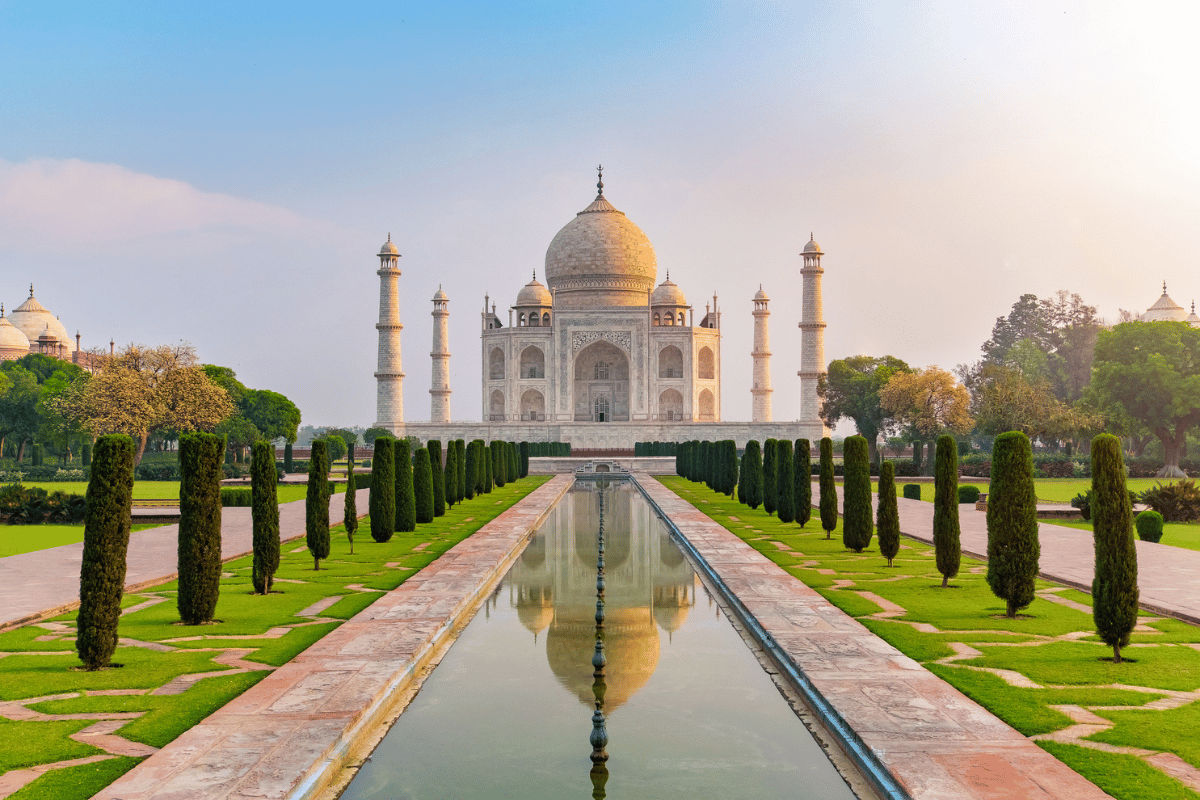
India is also astonishingly beautiful, deeply ancient, extraordinarily varied, endlessly fascinating, and home to some of the world’s greatest cuisine and some of its most extraordinary monuments. The Taj Mahal at sunrise is one of those rare experiences that actually exceeds its reputation. The spice markets of Kochi, the backwaters of Kerala, the painted havelis of Rajasthan, the cave temples of Ellora and Ajanta, the ghats of Varanasi at dawn – these are experiences that belong in any serious traveler’s life.
When to Visit India
India has distinct regional climate patterns, and the country is large enough that good travel conditions exist somewhere virtually year-round. For first-time visitors planning a classic northern itinerary (Delhi, Agra, Jaipur, the Rajasthan circuit), the best time is October through March, when temperatures are manageable and rainfall is minimal. April through June brings intense heat across northern India. The monsoon season (July through September) brings heavy rainfall but also dramatic landscapes and significantly reduced crowds and prices.
For southern India (Kerala, Goa, Tamil Nadu, Karnataka), the climate is more tropical and the peak season slightly different. Kerala is beautiful in the winter months, while Goa is perfect from November through February. The hill stations (Shimla, Darjeeling, Ooty) offer cool relief even in summer and are charming destinations year-round.
Classic First-Time India Itinerary: The Golden Triangle
The Golden Triangle – Delhi, Agra, and Jaipur – is the standard introduction to India for first-time visitors, and it earns its status. The three cities offer a concentrated dose of Mughal imperial history, Rajput royal culture, extraordinary food, and the two most famous monuments in India (the Taj Mahal in Agra and the Amber Fort in Jaipur), all within a manageable area and excellent road and rail connections.
Delhi (2 to 3 Days)
Delhi is a city of layers, with history spanning millennia compressed into a metropolitan area of 32 million people. Old Delhi (the Mughal-era city around the Red Fort and Jama Masjid) is chaotic, colorful, and completely unlike anything in Western travel experience. New Delhi (the colonial-era capital built by the British) is wide boulevards and grand government buildings. The new Delhi of Hauz Khas, Lodhi Colony, and Connaught Place is contemporary restaurants, galleries, and a cosmopolitan young population. Plan at least two full days and ideally three.
Agra and the Taj Mahal (1 to 2 Days)
Agra itself is not a particularly appealing city beyond its monuments, but the monuments are extraordinary: the Taj Mahal (go at sunrise, before the crowds peak), Agra Fort (the massive Mughal citadel overlooking the Yamuna), and the abandoned royal city of Fatehpur Sikri 40 kilometers away. Stay at least one night so you can experience the Taj both at sunrise and at sunset, and ideally on a full moon night when it is open for night viewing.
Jaipur (2 to 3 Days)
The “Pink City” of Rajasthan is one of the most visually striking urban environments in India, its old city painted in shades of terracotta pink since 1876 (when the city was painted to welcome the Prince of Wales). The Amber Fort above the city is a masterpiece of Rajput architecture. The City Palace, the Jantar Mantar astronomical observatory (a UNESCO World Heritage site), and the havelis of the old city are all extraordinary. Jaipur is also one of India’s great shopping destinations for textiles, jewelry, block-printed fabrics, and blue pottery.
Extensions Worth Considering
Kerala is India’s most consistently praised southern state for tourism: the backwater canal system (navigated by traditional houseboat), the hill station tea gardens of Munnar, the Ayurvedic wellness tradition, and the extraordinarily flavorful coastal cuisine all make Kerala a natural complement to a northern India itinerary for travelers with two weeks or more.
Varanasi, on the banks of the Ganges, is India’s holiest city and one of the oldest continuously inhabited cities in the world. The dawn boat ride along the ghats – the series of steps descending to the sacred river where Hindu pilgrims bathe, priests perform fire ceremonies, and the cycle of life and death is conducted in public with a directness that most Western travelers find profound – is one of the most moving travel experiences in Asia.
Practical Information for American Travelers
Visas are required for Americans visiting India and must be obtained before arrival. The e-Tourist Visa is straightforward to apply for online and covers tourism, yoga programs, and short medical treatments. It is valid for 60 days from the date of entry and allows double entry. Apply at least 4 business days before your trip begins.
Vaccinations recommended for India include Hepatitis A and B, Typhoid, and Tetanus-Diphtheria. Malaria prophylaxis is recommended for some regions and not others; consult your doctor or a travel medicine clinic at least 4 to 6 weeks before departure for personalized advice.
Food and water safety is important. Drink only bottled or filtered water, avoid ice in casual establishments, and be thoughtful about raw vegetables and unpeeled fruit from street stalls. That said, the food in India’s reputable restaurants, hotel kitchens, and mid-range eateries is extraordinarily good and generally safe to enjoy without excessive anxiety.
Download Google Maps offline for the regions you are visiting, and get a local SIM card upon arrival (available at all major airports) for data access. Cellular connectivity in Indian cities is excellent and data is inexpensive by American standards.
Should You Go With a Tour or Independently?
For first-time visitors to India, a guided tour with a reputable operator is strongly recommended. Not because independent travel in India is impossible (it is very much possible and rewarding for experienced independent travelers), but because the density of context required to fully understand what you are seeing is enormous, and a good guide transforms the experience from a series of impressive monuments into a living story of one of the world’s great civilizations. The difference between seeing the Amber Fort with and without an expert guide who can explain the architectural symbolism, the royal history, and the engineering ingenuity of its water systems is the difference between a superficial visit and a profound one.
For a second trip, independent travel becomes much more accessible and rewarding as your familiarity with Indian logistics, customs, and geography grows.
Plan Your India Trip With Atlas
Atlas Cruises and Tours designs India itineraries for all types of travelers, from first-timers doing the Golden Triangle classic to experienced explorers combining southern temple circuits with Kerala houseboats and Himalayan hill stations. Contact our India specialists today to start planning a trip that does justice to one of the world’s most extraordinary destinations.
Frequently Asked Questions
India is generally safe for prepared travelers, especially on well-planned itineraries. Common-sense precautions, trusted transport, reputable accommodations, and ideally a guided or specialist-arranged trip make a first visit comfortable and rewarding.
The classic first-timer route is the Golden Triangle: Delhi, Agra for the Taj Mahal, and Jaipur. It packs in the country’s most iconic sights over a manageable distance, and it pairs easily with extensions for travelers who want more.
The most comfortable window for the Golden Triangle and much of northern India is the cooler, drier season from roughly late autumn through early spring. Summer is very hot and the monsoon brings heavy rain, so timing makes a real difference.
Yes. American travelers need a valid visa, and India offers an electronic visa option for tourism. Apply well before departure and confirm current requirements, since entry rules can change.
First-time visitors usually do best on a guided tour or a specialist-arranged private itinerary. India rewards local knowledge, and having transport, hotels, and logistics handled lets you focus on the experience rather than the complexity.
Stick to bottled or purified water, skip ice of unknown origin, and favor freshly cooked, hot dishes and busy, reputable restaurants. India’s food is a highlight of any trip, and a few simple habits let you enjoy it with confidence.