
If you have priced a flight for summer in the past few weeks, you already know something is off. Fares are higher, airline schedules are shifting, a major US carrier has gone out of business, and even the legacy airlines are quietly trimming what your ticket includes. After more than two decades helping travelers plan vacations, I have not seen a summer like this one in a long time.
The good news? My clients are still taking the trips they have been dreaming about. They are just being smarter about how they book, what they book, and (in many cases) whether a plane is the right vehicle for their summer at all.
This guide is the same advice I give clients who walk through our doors at Atlas Travel. It is what is actually working right now, why airfares look the way they do, and how to lock in real value on flights, cruises, escorted tours, and vacation packages this season.
Why Airfares Are So High Right Now (And Why It Is Not Going Away Soon)
Simply put: oil prices spiked, jet fuel costs more than doubled in some markets, and several major carriers are scaling back operations to cope.
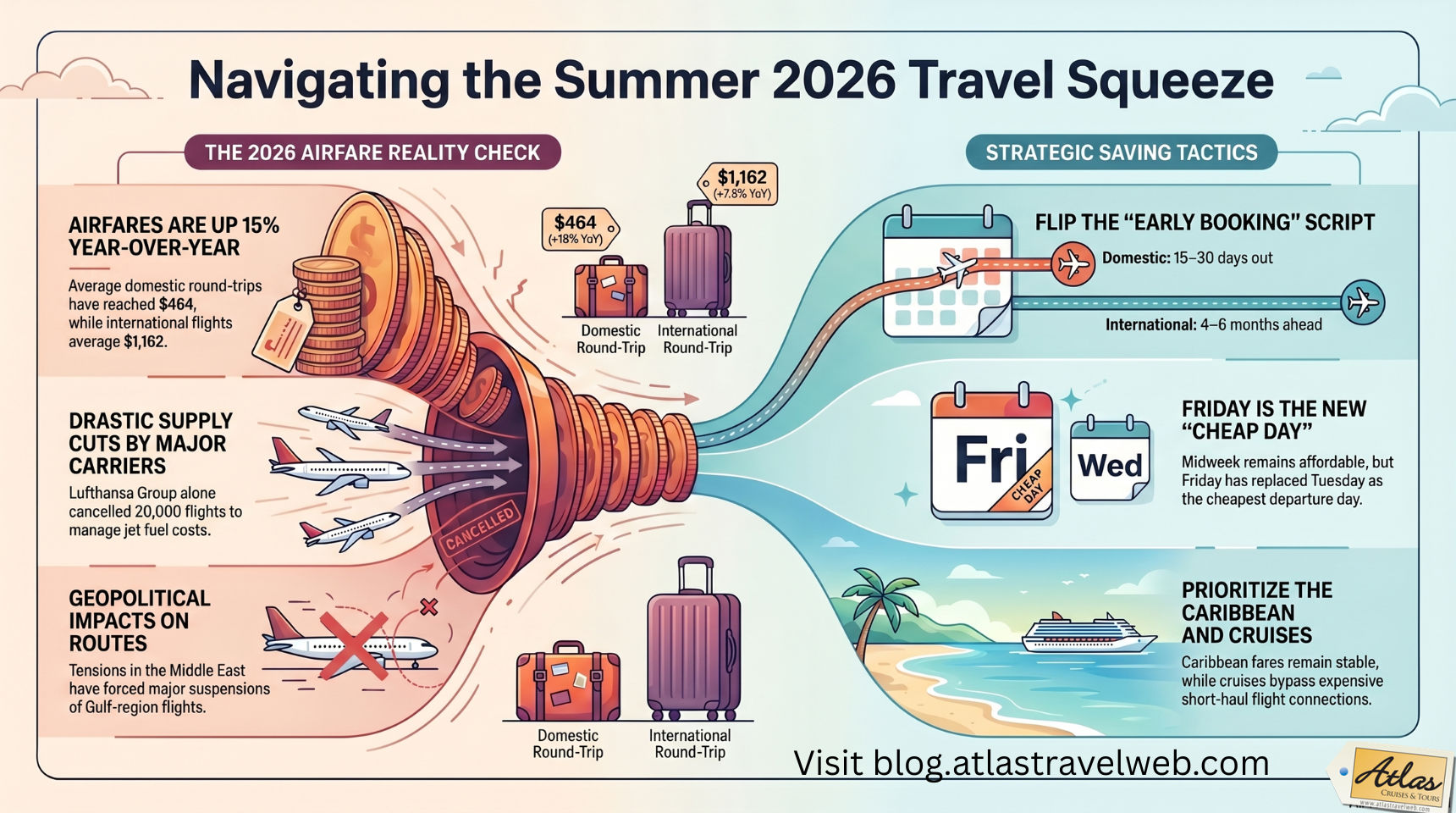
The Lufthansa Group (which includes Lufthansa, SWISS, Austrian Airlines, Brussels Airlines, ITA Airways, and Eurowings) recently cancelled roughly 20,000 short-haul flights through October to save more than 40,000 metric tons of jet fuel. Additionally, this group permanently shut down its CityLine regional subsidiary, grounding 27 aircraft and dropping or rerouting more than a dozen short-haul European routes from hubs like Frankfurt and Munich.
British Airways has suspended Gulf routes, including Dubai and Abu Dhabi, over safety advisories tied to Middle East tensions, and parent company IAG has acknowledged sharp fuel-price pressure. Air France-KLM has already raised long-haul economy round-trip fares by roughly €100 $117 USD, and fares to the US, Canada, and Mexico by €70 $82 USD.
How Route Cuts Are Affecting Global Fares
Asia is feeling it too. Refineries in China, South Korea, and India rely heavily on Middle East crude oil and are struggling to meet jet fuel demand. Some Europe-to-Asia routes have seen fares rise as much as fivefold. Long-haul international flying is hit hardest because fuel is the dominant cost driver on long flights; the longer the route, the more fuel prices flow directly into the ticket price.
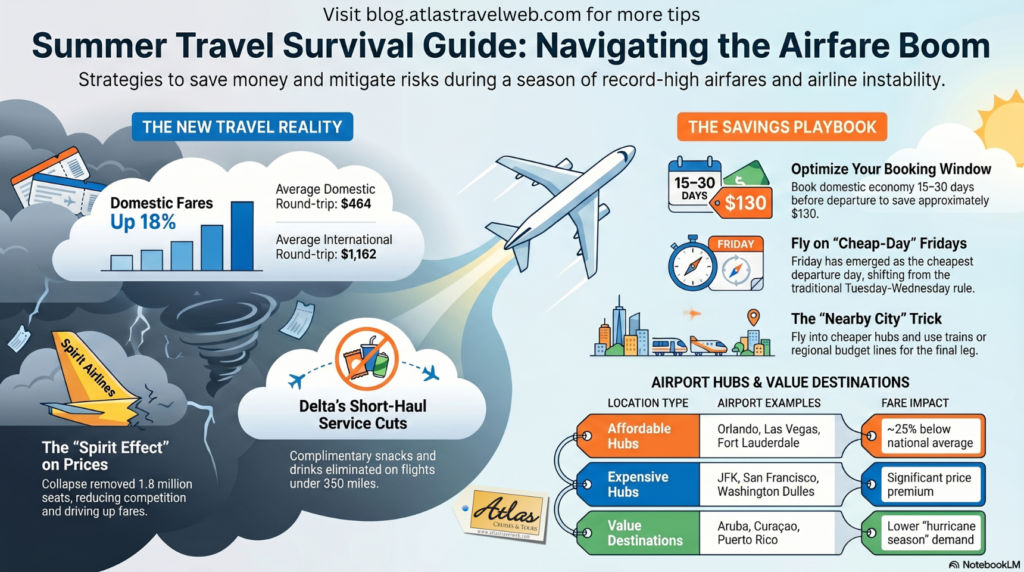
Closer to home, Bureau of Labor Statistics data shows US airfares climbing nearly 15 percent year over year. The flight deal service Going pegs the average domestic round-trip for summer at around $464 (up roughly 18 percent), and international round-trips at around $1,162 (up about 7.5 percent). United Airlines and Southwest executives have both told investors they have raised fares five times in recent months, and neither expects prices to drop quickly.
So if you are flying this summer, you need a strategy. Here is what I would tell you if you were sitting in my office.
What Spirit Airlines’ Shutdown Means for Your Wallet
Spirit Airlines recently announced an immediate, orderly wind-down of all operations. Every flight has been cancelled. Customer service has been closed. The airline’s app now displays a single message telling travelers their flights are cancelled and not to come to the airport. This is the first major US airline to go out of business in 25 years.
Spirit had been working through its second bankruptcy in less than a year and had reached a deal with creditors to emerge leaner and keep flying. Days later, the war in Iran sent jet fuel prices nearly doubling, and Spirit’s ultra-low-cost model could not absorb the hit. An eleventh-hour bailout deal with the Trump administration collapsed when key creditors rejected the terms. By early one Saturday morning, Spirit was done.
The market impact is real. Spirit accounted for roughly 2 percent of US domestic flights this summer (about 9,000 cancelled flights and 1.8 million seats just in May alone). Removing that capacity will push fares higher across the entire US airline industry, especially on routes where Spirit competed aggressively (Fort Lauderdale, Las Vegas, Orlando, Detroit, Atlantic City, and Dallas).
What to do if you have a Spirit ticket
Direct bookings with Spirit using a credit or debit card will be automatically refunded. Those who booked through a travel agent should contact the agent directly, as they will handle it. Customers who paid with a voucher, travel credit, or Free Spirit points may be out of luck for now — refunds in those categories will be determined through the bankruptcy court process.
Travelers who are mid-trip and stranded will find that several airlines have stepped in with rescue fares. Southwest is offering $200 fares for flights up to 500 miles, $300 for 501 to 1,000 miles, and $400 for flights over 1,000 miles, available at airport ticket counters with proof of your cancelled Spirit booking. United has capped Spirit-customer fares at $299 (with most priced at $199). American, JetBlue, and Frontier have also rolled out rescue fares.
If your refund does not appear within 30 days, file a credit card chargeback. Federal law gives you the right to dispute charges for services not delivered.
What this means for everyone else
Even if you have never flown Spirit, this affects you. Budget carriers force the legacy airlines to keep fares competitive on overlapping routes. With Spirit gone, expect prices from Fort Lauderdale, Las Vegas, Orlando, and other Spirit strongholds to climb in the coming weeks.
It is also a good moment to remember why working with a travel advisor matters in a year like this. Agent-booked tickets get handled by the agent, not by an airline call center that no longer exists. When the news breaks at three in the morning, your advisor is already on it.
And Now Delta Is Cutting Service Too
Delta has announced that it will eliminate all complimentary food and beverage service on flights under 350 miles for everyone except Delta First passengers. That includes Delta Main and Delta Comfort+, so paying for an upgraded seat will not protect you from the cut.
The change affects roughly 450 daily flights, including some of the busiest short-haul corridors in the country (Los Angeles to San Francisco, New York JFK to Boston, Atlanta to Charlotte). If your flight is under an hour and covers less than 350 miles, expect no drink cart, no snacks, no coffee.
To be fair, the news is not all bad. About 600 daily Delta flights in the 350-to-499-mile range will actually be upgraded from old “express” service (water, coffee, tea only) to full beverage and snack service. Depending on your route, you may come out ahead.
Still, this puts Delta at the strictest end of the legacy-carrier spectrum. American Airlines starts service at 250 miles, United at 300 miles, Delta now at 350. The takeaway: check the actual mileage of your flight (not just the duration) before assuming a snack will appear, and grab what you need at the terminal before boarding short-haul Delta flights.
How to Save on Domestic Flights This Summer
After watching this market shift week by week, here is the playbook I am giving clients right now.
Best Airports and Timing for Low Fares
A few quick wins that consistently save my clients real money. If you have any flexibility on where you depart from or when you fly, these are the levers to pull first.
- Cheapest US departure airports. Per Expedia, Fort Lauderdale, Las Vegas, and Orlando are the most affordable mainstream US departure airports, with average fares roughly 25 percent below the national average. If you live within driving distance of one of these, the math often favors a 90-minute drive over your closer airport.
- Most expensive US departure airports. Washington Dulles, San Francisco, and New York JFK consistently rank as the priciest in the country. If you live in a market with multiple airport options (the New York area’s JFK, LaGuardia, and Newark are the classic example), run the numbers across all of them before booking.
- Cheapest weeks of summer. Late August and the first half of September tend to be roughly 20 percent cheaper than the rest of the summer season. School districts now start earlier across much of the country, which has shifted family travel forward and softened demand later in the season. If you can swing a back-to-school-week getaway, this is the window.
- The “nearby city” trick for international travel. Cannot find a cheap flight to your final destination? Fly into a cheaper major hub and use a regional budget airline, train, or ferry to reach your final stop. Flying into Athens and ferrying to Santorini, or flying into Madrid and training to Lisbon, can save hundreds per ticket compared to direct service. This is also the strategy that makes river cruises such a smart European pairing: one transatlantic flight in, then the ship handles the rest.
Book in the right window, not as early as possible
The old wisdom of “book six months out” no longer holds for domestic. Expedia’s Air Hacks Report found that the most affordable booking window for domestic economy is 15 to 30 days before departure (with average savings of about $130 over flights booked six or more months in advance). For peak summer routes that are filling up fast, two to three months out is a safer buffer. Do not panic-book too far ahead, but do not wait until the last week either.
Fly midweek, especially Friday and Tuesday
Tuesdays, Wednesdays, and Fridays now dominate the cheap-day rankings. Expedia’s recent data points to Friday as the single cheapest day to depart, a meaningful shift from the old Tuesday-Wednesday rule. Business travelers head home earlier in the week now, which frees up Friday seats for leisure flyers. Sundays remain the most expensive day. If your schedule lets you skip the Friday-night-out, Sunday-night-back pattern, you save real money.
Travel carry-on only
Delta, United, JetBlue, and other major carriers have all raised checked bag fees this year. As an example, that airline now charges $45 for a prepaid first checked bag, $50 if you wait until 24 hours before. A family of four checking one bag each round-trip can drop $400 just on luggage. Pack lighter, save bigger.
Set fare alerts and act fast when they ping
Tools like Google Flights, Hopper, Kayak, and dedicated services like Going (formerly Scott’s Cheap Flights) flag price drops the moment they happen. Going members report average savings of $200 on domestic and $550 on international tickets. Set up alerts for your top three or four destinations, then move quickly when one drops.
Use points and miles aggressively
If you have been hoarding credit card points, this is the year to spend them. Award charts have not risen as fast as cash prices, so the relative value of miles is up. The strongest redemption opportunities right now are domestic main-cabin saver awards and partner-airline international economy redemptions.
Use the 24-hour rule to your advantage
By US Department of Transportation rule, US airlines must let you cancel within 24 hours of booking (as long as your flight is at least 7 days away) for a full refund. That means you can lock in a fare you like and keep watching for a better one. If a lower price drops the next morning, cancel and rebook.
How to Save on International Flights This Summer
International strategy is different from domestic, especially this year.
Book farther ahead for peak destinations
For peak-summer Europe trips, the historical sweet spot is four to six months in advance. Expedia’s data shows international travelers can save an average of $190 by booking 31 to 45 days ahead instead of six months ahead, but that window applies to flexibility on shoulder dates, not peak July departures to Rome or Paris.
Use the “nearby city” trick
Cannot find a cheap flight to your final destination? Fly into a cheaper nearby city, then use a regional budget airline, train, or ferry to get the rest of the way. Flying into Athens and ferrying to Santorini, or flying into Madrid and training to Lisbon, can save hundreds per ticket compared to direct service. This is the same logic that makes river cruises such a smart European pairing: one transatlantic flight, then the ship handles the rest.
Look at the Caribbean before Europe
The Caribbean is the best international value of the summer. Hurricane season suppresses demand, which keeps fares low. Aruba, Curaçao, Puerto Rico, and Jamaica all sit below or at the southern edge of the hurricane belt, which means lower weather risk and lower prices. Many of these destinations are reachable on direct flights from the southeastern US in under four hours. Browse our Caribbean vacation packages to see what the all-inclusive math looks like.
Aim for August in Europe
If Europe is non-negotiable, August is your friend. June and July round-trips from major US cities to Europe are running $600 to $800 and up, while August fares often run noticeably lower as European demand patterns shift and locals themselves go on holiday.
Build in disruption insurance
With Lufthansa cuts and route suspensions still rolling out, build a buffer day on each side of your itinerary. If you have a connection through Frankfurt or Munich, ask about rerouting through Zurich, Vienna, or Brussels (all of which Lufthansa is actively expanding to absorb displaced passengers). Travel insurance is more important this season than it has been in years (more on this below).
Why a Cruise May Be Your Smartest Move This Summer
Here is what most articles miss: when airfare gets unstable, cruises start to look like one of the best deals in travel.
A cruise bundles your transportation, lodging, meals, entertainment, and (usually) several destinations into one fixed price. Once you are on the ship, the airfare market does not affect you anymore. Cruise lines hedge their fuel costs in advance, source from multiple suppliers, and operate under contracts that insulate passengers from the day-to-day volatility air travelers are experiencing.
Even better, most cruises out of US homeports do not require an international flight at all. A round-trip cruise from Galveston, Miami, Tampa, Fort Lauderdale, New York, Los Angeles, Seattle, or San Diego can take you to the Caribbean, Mexico, Bermuda, Alaska, or Canada and New England without a single international airport in your itinerary. For travelers in Florida, Texas, and the West Coast, this is a real advantage right now.
A few specific reasons cruises deserve a serious look:
Key Reasons Cruises Make Sense Right Now
- Predictable pricing. What you book is what you pay (plus taxes, port fees, and on-board extras). Compare that to airfare prices that have moved five times in a few months.
- No fuel surcharges on existing bookings. Most cruise lines have honored existing fares without adding fuel surcharges this season.
- All-inclusive value. Three meals a day, lodging, entertainment, kids’ programming, and transportation between four to seven destinations is hard to beat on a cost-per-day basis once you compare it apples-to-apples against a land vacation.
- Built-in flexibility. Last-minute cruise deals appear constantly throughout the summer and are often dramatically cheaper than booking a comparable land vacation on short notice.
- Variety of styles. Whether you want a budget Caribbean sailing on Carnival or Royal Caribbean, a refined experience on Celebrity or Holland America, or an ultra-luxury sailing on Regent Seven Seas or Silversea, there is a cruise line that matches your budget and travel style.
Last-Minute Cruise Deals Worth Looking At
For the full list (filterable by price, cruise line, length, and departure port), head to our last-minute deals page. New sailings are added constantly. You can also browse our broader cruise specials for early-bird deals on later-season sailings.
Where the Smart Money Is Going This Summer
If you have not picked a destination yet, here is where deals exist and where your dollar will go furthest right now.
Best international value: The Caribbean
Aruba and Curaçao sit outside the main hurricane belt, which makes them strong choices for July and August travel. Puerto Rico requires no passport for US travelers and has direct service from dozens of US cities. Jamaica and the Dominican Republic are home to many all-inclusive resorts that lock in your costs the same way a cruise does. Browse our Aruba, Jamaica, or Dominican Republic packages to see current pricing.
Best cruise value: Alaska and the Pacific Coast
Alaska season runs through September, and last-minute cabins on shoulder-week sailings show strong value. Pacific Coast cruises out of Los Angeles or San Francisco are short, scenic, and require no international travel.
Best escorted tour value: National Parks, Iceland, and Ireland
Escorted tours are having a moment because they bundle transportation, lodging, and most meals the same way a cruise does. Our National Park tours avoid international airfare entirely. Iceland and Ireland tours from operators like Globus, Tauck, and Collette are popular hedges against airfare uncertainty because once your tour starts, your costs are locked in.
Best drive-trip value: National Parks and the American South
If gas prices have you worried about a road trip, Oklahoma, Kansas, North Dakota, Texas, Nebraska, Iowa, Missouri, Arkansas, Louisiana, Mississippi, and Georgia have the lowest fuel prices in the country right now. The southern Appalachians (Asheville, Cashiers, Blowing Rock, the Blue Ridge Parkway) are stunning in summer and accessible from much of the eastern US without flying.
Best Europe value: River cruises and August departures
European river cruises sidestep the entire short-haul flight problem. Once you are on the ship, you are gliding from city to city without ever boarding another flight. AmaWaterways, Avalon, Viking, and Uniworld all run summer Danube, Rhine, and Rhône itineraries that pair beautifully with one transatlantic flight booked well in advance.
Best group travel value: Friends, family, and book club trips
Group rates almost always beat individual pricing, and when airfare is unpredictable, group bookings give you negotiating leverage that solo travelers do not have. We help families, friend groups, and clubs build custom group trips that lock in pricing for everyone.
Why Travel Insurance Matters More Than Ever Right Now
I bring this up because clients ask me about it constantly: in a normal year, travel insurance is worth considering. This year, it is essential.
Cancel-for-any-reason (CFAR) coverage is the gold standard if you want maximum flexibility. Standard travel insurance typically covers cancellations for specific covered reasons (illness, family emergency, severe weather), but CFAR lets you cancel for almost any reason and recover a portion of your trip cost (typically 50 to 75 percent). It costs more, but in a season with airline shutdowns and route suspensions, the math often favors having it.
A few things to look for in any policy: trip interruption coverage (in case you are stranded mid-trip), supplier default coverage (in case an airline or tour operator goes out of business), and emergency medical coverage (especially for international travel where your US health insurance does not work).
If you book through us, we will walk you through the options and find a policy that fits your trip. We do not sell insurance directly, but we will help you compare reputable providers.
Frequently Asked Questions
Will airfare prices come down soon?
Probably not in the next several months. Both United and Southwest executives have publicly told investors they have raised fares five times in recent months and do not expect prices to drop. The two factors driving prices (jet fuel costs and reduced industry capacity from Spirit’s shutdown) are structural, not temporary. Plan around current pricing rather than waiting for relief.
Should I book my summer flight now or wait?
For domestic flights, book in the 15-to-30-day window before departure for the best price. When it comes to peak international destinations like Europe, book four to six months out (you are already late if you are booking peak Europe right now). The risk of waiting is higher than the risk of booking early in this market because capacity is shrinking.
What is the cheapest day to fly?
Friday is now the single cheapest day to depart, according to Expedia’s most recent Air Hacks Report. Tuesday is second cheapest. Sunday is the most expensive. This is a shift from the old “always fly Tuesday or Wednesday” rule (business travelers now head home earlier in the week, freeing up Friday seats for leisure flyers).
Are cruises actually cheaper than flying somewhere?
For comparable trips, almost always yes (especially right now). A seven-night Caribbean cruise from a US homeport often costs less than a week at an all-inclusive resort once you factor in airfare, hotel, meals, entertainment, and ground transportation. The cruise also locks in your pricing the day you book, while airfare and hotel rates can climb between booking and departure.
What happens if my airline goes out of business after I book?
If you booked with a credit or debit card, federal law lets you dispute the charge under the Fair Credit Billing Act and recover your money. If you booked with cash, vouchers, or points, you may have to wait through the bankruptcy court process and may recover less than you paid. This is one of the strongest reasons to use a credit card and to consider trip insurance with supplier default coverage.
Is it worth using a travel agent in the age of online booking?
Honestly? Yes, especially this year. We have direct relationships with cruise lines, tour operators, and resorts that give us access to pricing, cabin categories, and inventory that the public sites do not see. When something goes wrong (a cancelled flight, a missed connection, an airline shutdown), we are the ones who fix it. And our services are typically free to you because suppliers pay us, not you.
Are last-minute cruise deals safe to book?
Yes, when they come from a reputable source. Last-minute deals exist because cruise lines would rather sail with full ships at a discount than half-empty ships at full price. Our last-minute cruise deals page only lists deals from established cruise lines, and every booking is protected by the cruise line’s own cancellation policies plus any travel insurance you add.
Is it safe to travel to the Caribbean during hurricane season?
The risk is real but manageable. Aruba, Curaçao, Bonaire, and the southern coasts of Mexico sit outside or at the edge of the main hurricane belt. The peak hurricane risk is mid-August through mid-October, so early summer (June and early July) carries lower risk. Travel insurance with weather coverage is strongly recommended for any Caribbean booking during this window.
What if I have already booked a flight and the price drops?
Most US airlines no longer charge change fees on standard economy fares (basic economy is the exception). If the price drops, you can typically cancel and rebook at the lower price, then use the credit from your original booking. Within 24 hours of booking, you have an automatic right to a full cash refund under Department of Transportation rules.
Should I be worried about flying after Spirit’s shutdown?
Not from a safety standpoint. Spirit’s shutdown was financial, not operational, and the remaining US airlines (Delta, United, American, Southwest, JetBlue, Alaska, Hawaiian, Frontier, Allegiant) are all financially stable. The bigger concern is fare increases on routes where Spirit competed, which is why booking sooner rather than later makes sense this season.
The Bottom Line
This summer is shaping up to be the most expensive flying season in years, and the situation behind it (jet fuel prices, geopolitical tensions, schedule cuts, and one major airline shutdown) is not going to be resolved in the next few weeks. But that does not mean your vacation has to take the hit.
For domestic flights, book in the 15-to-30-day window, fly midweek, use cheaper airports, pack carry-on, and put your points to work. When traveling internationally, look at the Caribbean before Europe, aim for August if Europe is essential, and build in disruption insurance.
And if airfare is breaking your budget altogether, a cruise from a US homeport, an escorted tour with locked-in pricing, or a group trip with friends or family may be the most strategic moves you can make this season.
Should You Work With a Travel Advisor?
If you would like help finding the right cruise, tour, or vacation package for your dates and budget, that is exactly what we do every day. Browse our last-minute cruise deals, check our cruise specials, explore our escorted tours, or call us at 1-800-942-3301. We will help you put together a summer trip that protects your wallet and still feels like the getaway you have been waiting for.
Atlas Travel is a member of IATA, ASTA, CLIA, and the Signature Travel Network, with over two decades of experience helping travelers across the country plan smart, memorable trips.