
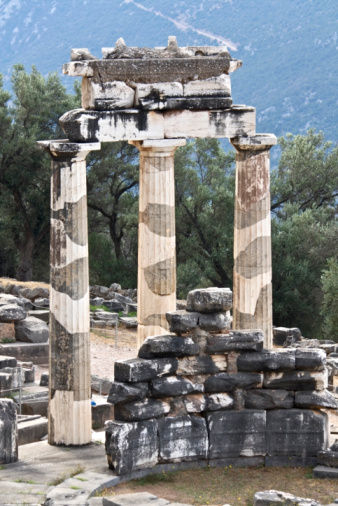
Delphi is an important archaeological site and a modern town located in the valley of Phocis in Greece. Delphi is also considered to be one of the most beautiful ancient sites in Greece, with gorgeous views of mountains and ancient ruins. In Greek mythology, it is known as the center of the world, and known for being the site of the Delphic oracle. It is said that Zeus released two eagles, each at opposite ends of the earth, and they met directly above Delphi. They impaled one another with their beaks and fell to the ground below, on the exact spot marking the center of the world. Here a sacred stone called the Omphalos, meaning ‘belly button’, marked the site. According to legend, Apollo killed the serpent named Python, son of Mother Earth and guardian of Delphi’s Castalian Spring. The sun god, Helios, then set up an oracle at the spring, assuring to give advice and counsel to any that needed it.
Most people don’t have a clue as to why they’re visiting Delphi when they do… They just know that it’s something you’re supposed to do when you’re traveling around and visiting Greece. One of the major reasons to go is because of the beautiful old buildings and ruins that cover Delphi. There’s the Delphi amphitheater that had been originally built in the 4th century B.C., but had been remodeled in several cases afterward. It has 35 rows and can seat up to 5,000 people.
Another of the major reasons to visit Delphi, Greece is to visit the site of the Delphic Oracle. The Oracle of Delphi, also known as the Pythia, was established by Helios in the 8th century B.C., and was the priestess at the Temple of Apollo in Delphi. The Pythia was widely known and recognized for the prophecies she gave that were inspired by Apollo. The Oracle would only give her prophecies during the 9 warmest months. In the winter months, Apollo deserted his temple and Dionysus, his half-brother, would take his place. Apollo would then return at the beginning of spring, and the Oracle would then resume her duties.
After Apollo’s return, the Oracle would, once a month, begin preparing to communicate with the divine by undergoing purification rites, which included fasting. On the 7th day of every month, she would cleanse herself in the Castalian Spring, and drink the holy water of the Kassotis. The Oracle would then go down into the adyton (which is Greek for ‘inaccessible”), climb up onto her tripod-shaped seat, and hold a branch of laurel and a bowl of water from the Kassotis spring, which she would gaze into. It is here that she would give counsel to consultants. Consultants would carry branches of laurel with them as they approached the temple, making their way down the winding trail of the Sacred Way, bringing along an animal sacrifice and money for the admission fee. The animal was usually a goat, and would be washed with water and made sure that it shivered from its hooves up, which was apparently a good omen. After sacrifice, its liver was also examined to make sure it was in good condition; otherwise the consultation with the Oracle would not be able to proceed.
The last recorded response from the Oracle was given in 393 A.D., which is when emperor Theodosius ordered that all pagan temples would cease operation. The movie My Life in Ruins, starring Nia Vardalos and Richard Dreyfuss, provides some great sightseeing throughout Greece including Delphi.
Plan your Greece tour today!
The Oracle of Delphi is one of ancient Greece’s most fascinating historical sites. Our advisors’ Best Islands in Greece guide explores Greece’s extraordinary blend of history and natural beauty.