Historical records dating back over 3,000 years confirm Beijing’s prominence as a thriving community. But it was Kublai Khan – grandson of the Mongol leader Genghis Khan, conqueror of northern China in AD 1215 – who established the city as capital of the newly-declared Yuan Dynasty. During his reign the city truly blossomed; imperial palaces were built, streets were broadened, temples constructed, and canals completed. Burgeoning trade brought unprecedented wealth to the city. The Silk Road routes, established in the first century BC, flourished once again, bringing western gold and silver to adorn Beijing’s new palaces.
Today, Beijing remains as China’s unrivaled political and cultural capital – a national treasure of museums, government buildings, religious temples, gardens and parks. Here, visitors are presented the often conflicting essence of modern China: glassy shopping centers abut thousand-year-old temples; itinerant workers share sidewalks with dapper entrepreneurs; fast-food outlets and punk clubs compete with teahouses and opera houses.
The Forbidden City:
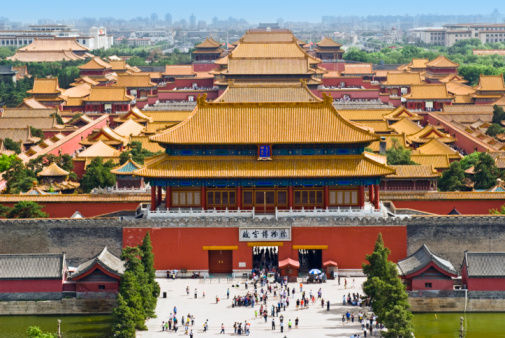
Off-limits to the public through 24 emperors and nearly 500 years, the complex of imperial palaces, courts and museums (totaling over 8,000 rooms) is Beijing’s #1 attraction. A 30-foot-high wall and 20-foot-deep moat surround the city which, at 170 acres, is almost twice the size of the Kremlin and more than three times the size of Buckingham Palace. The Forbidden City’s last stone was put in place in 1420 – a lifetime before Christopher Columbus crossed the Atlantic.
Jing Shan Park:
For the most scenic views of the Forbidden City, this is the place to come. The park features a tall, man-made hill created from soil moved in the Ming Dynasty construction of the moat which surrounds the Forbidden City. The hill’s placement was chosen for its favorable position; according to feng shui precepts, it blocks the chilling winter winds from the north while offering an auspicious link to the Ming Tombs located in the city’s northern suburbs.
Tiananmen Square:
Through the years this 100-acre square has been the venue for both “staged events” (celebrations of steel production, tributes to Stalin, etc.) and “unstaged events” (1989 Tiananmen Square incident). Flanked by colossal, Soviet-era buildings and dotted with monuments, it was here in 1949 Mao Zedong proclaimed the foundation of the “People’s Republic,” and it’s here where he was entombed 27 years later. By Beijing’s timeline, Tiananmen (“Gate of Heavenly Peace”) Square is a newcomer, created in the 1920s and expanded again in the late 1950s in time for the Republic’s 10th anniversary.
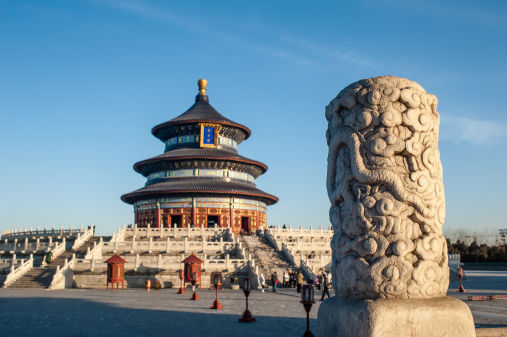 Temple of Heaven:
Completed during the Ming Dynasty, the structure is often considered the quintessential Chinese temple as it incorporates some of the finest architectural talents found anywhere in the nation – and not a nail used anywhere! The emperor was considered a son of heaven, so this is where his celestial communications took place – where prayers to ancestors and the heavens sought favorable weather and bountiful harvests.