
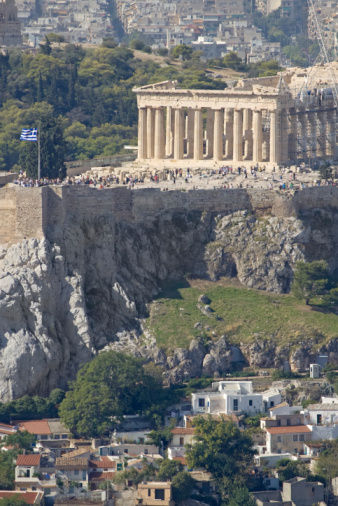
Plaka is the famous historical neighborhood of Athens, Greece, and is located between Syntagma and Monastiraki Square below Acropolis, or ‘highest city.’ Plaka was built on top of residential areas of Athens, and is known as the “Neighborhood of the Gods” due to its closeness of Acropolis and many of the archaeological sites. Before the Greek War of Independence, Plaka was known by many different names including Kontito, Kandili, and Alikokou. It wasn’t until the first years of King Otto’s ruling that the name Plaka was commonly used. No one is quite certain of the origin of the name, but the common theory is that it came from ‘Pliak Athena’, which means ‘Old Athens’.
Plaka was known as the ‘Turkish quarter of Athens’ during the years of Ottoman rule, and the seat of the Turkish governor. Like the rest of Athens, Plaka was temporarily abandoned by its residents because of the relentless battles that took place in 1826 during the Greek War of Independence, but was repopulated during the ruling of King Otto. In 1884, a large part of the neighborhood was burned down by a fire, allowing archaeologists to hold excavations in Hadrian’s library and the Roman Market. Since the 19th century, excavations have been occurring continuously.
The Plaka today is a definite tourist area, with many different cafes, souvenir shops, and museums to visit and check out. It’s also a pretty small place, as it takes only around 20 minutes to walk from one side to the other. That’s also a plus, because motor vehicles aren’t allowed in the Plaka, which wouldn’t fit anyway due to the small, narrow streets and alleyways. Walking around, you may notice that there isn’t any electricity or telephone poles and wires around—that’s because Plaka is the only place in Athens where all the utilities, including water, telephone, and electricity, are underground in custom-made tunnels.
While visiting Plaka, be sure to visit the Museum of Greek Folk Art! It has great exhibits (the oldest dating back to 1650) that reconstruct the lifestyles of the Greek people. There you can check out vibrant costumes that represent each region of Greece. You can also see Greek folk art such as pottery, paintings, silverware, embroidery, hand-woven rugs, and woodcarvings.
Another great place to check out is the Dora Stratou dance theatre. Here, from May to September, you can watch as 75 folk musicians, singers, and dancers reenact old folk songs and dances in authentic costumes, some of which are embroidered with real gold thread!
The best time to visit Plaka is probably between late April to early July, as Plaka has Mediterranean climates, and that period is usually the coolest, which is best for walking around the city.
Plan your Greece tour today!
Europe’s diversity of experiences makes it the world’s most popular travel destination. Our advisors’ Common Mistakes to Avoid When Traveling to Europe guide ensures every European trip exceeds expectations.