
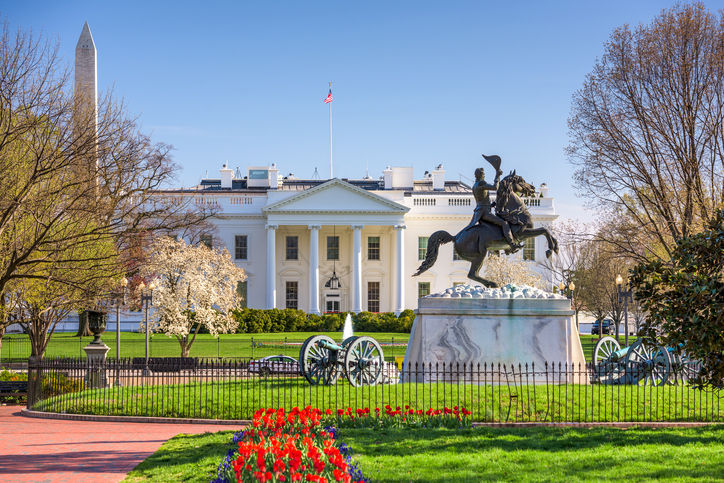
The White House is one of America’s most popular monuments for many different reasons. It has been the home to 42 Presidents, including President Barack Obama and excluding President George Washington. The White House was designed by an Irish architect by the name of James Hoban, and construction of the house began on October 13th, 1792. The house has six stories—a two-story basement, the Ground Floor, the State Floor, the Second Floor, and the Third Floor. It has 132 different rooms, 35 bathrooms, 8 staircases, 3 elevators, and 28 fireplaces. It also has 147 windows and 412 doors. The house also has recreational facilities, including a bowling lane, tennis court, movie theater, and jogging track. Construction of the White House was finished sometime in the year 1800, and President John Adams and First Lady Abigail Adams were the first residents to move in. The house is around 210 years old.
In 1814, during the war of 1812, British troops set the White House on fire, and the house was almost completely destroyed. President Madison and his wife stayed in the Octagon House while it was being reconstructed from 1815 to 1817. The White House has been known by many different names. Some of these names included “President’s Palace”, “Executive’s Mansion”, “President’s House”, and the “President’s Castle” as First Lady Dolley Madison dubbed it. The name “White House” became official in 1901 when President Theodore Roosevelt adopted it. The house became accessible by wheelchairs in 1933 when Franklin D. Roosevelt was in office. Because Roosevelt was confined to a wheelchair due to paralysis from polio, he had the White House remodeled to accommodate him, and even added an indoor heated pool for his therapy. In 1948, engineers declared that the White House was unsafe because it was in danger of collapsing due to weak wooden support beams and the exterior load-bearing walls, as they were 150 years old. President Truman had the interior gutted and new steel support beams added.
There are nine rooms that you can visit during your tour of the White House. These rooms include the State Dining Room, the Red Room, the Green Room, the East Room, the Library, the Vermeil Room, the China Room, and the Diplomatic Reception Room. The State Dining Room seats 140 guests, and was given its name during Andrew Jackson’s time in office. Mamie Eisenhower would decorate it for each holiday, including Halloween. The Red Room is filled with furniture that dates from 1810 to 1830, and was once the favorite sitting room of First Lady Mary Lincoln. Thomas Jefferson used the Green Room as a dining room, James Madison made it into a sitting room, and President Monroe and First Lady Monroe used it as a Card Room, with two playing tables. The East Room is used to host large gatherings, dances, and concerts, and is where Theodore Roosevelt’s daughter Alice was married. The library was made from a servants’ locker room in 1935. The Vermeil (pronounced vur-MAY) Room is sometimes known as the Gold Room, and it holds several portraits of past First Ladies, including Aaron Shikler’s painting of Nancy Reagan. The China Room holds china and glassware that represents past Presidents. The Diplomatic Reception Room was originally used as a boiler room and was occupied by a furnace, and is now used as an entrance from the South Grounds for the Presidential family.
Make sure to have your U.S. government-issued ID or drivers’ license upon arriving for your tour, and leave all bags, purses, cameras, food, and strollers behind. Cell phones, wallets, and keys are permitted inside, but use of phones is prohibited. Any phone found in use will be confiscated by the US Secret Service. In order to get a tour of the White House, you must call your senator or Congressman. Have the names of all people in your tour group, as well as their dates of birth and social security numbers, and when you are willing to tour the house. You must make reservations at least three months in advance. The tours are self-guided, and free of charge.
Smart travel budgeting starts with our advisors’ comprehensive travel savings guide — proven strategies from 30+ years of travel expertise.