

Like a flooding river, the Ancient Roman Empire crashed across continents. It encircled the entire Mediterranean basin: present-day Britain, Syria, Morocco and more. Expeditions trekked as far as Lake Chad in the central Sahara and the basaltic lava plains of Eastern Ireland.
Wherever they went, the Romans left clues: a lead drain pipe in Scotland, glass gambling dice in Carthage, and more than 230 stone amphitheaters scattered across the Mediterranean basin. The Coliseum in Rome is just the tip of the iceberg.
Ancient Roman Amphitheatres to Visit Throughout Europe
In Bosra, Syria, summer temperatures routinely climb over 90 degrees Fahrenheit. Clouds and trees are as rare as blueberry pancakes. So the Romans, who annexed Syria in 64 B.C., built a 15,000-spectator amphitheater in which a fine, perfumed mist of cool water sprayed over the audience. The freestanding semi-circle amphitheater, one of the few in the Roman Empire, boasts a stage 148 feet long and 26 feet deep. Even people in the nosebleed seats can easily hear the actors without amplification. Visitors nimble enough to surmount the steep stairways can test the acoustics for themselves. Please, speak in Latin.

Roman Theatre at Bosra, Syria
Designed by a Greek, built for Rome and later remodeled into a Sunni Muslim palace, the Aspendos theatre in Turkey is the best-preserved Roman theater of antiquity. Crafted from cream-colored limestone blocks, the theatre seats 10,000-15,000 and features a vaulted stage hovering seven feet above the ground. Visitors can wander around the site or attend seasonal events hosted by the Aspendos International Opera and Ballet Festival. Look for inscribed names of theater patrons on seats in the upper-level cavea.

Aspendos Theatre in Turkey
In any other city, the two Roman amphitheaters of Jerash, Jordan, both beautifully preserved examples of Vitruvian architecture, would be superstar tourist attractions. In Jerash, however, they are e pluribus unum: one out of many. Polka-dotting the city are ancient marble baths, temples, colonnades and the hippodrome, which still hosts gladiator games and chariot races during the Roman Army and Chariot Experience (RACE). Visitors can cheer for their favorite actors, for the brave desperate men who stood before bloodthirsty crowds and said, “Ave, imperator, morituri te salutant!” – “We who are about to die salute you!”
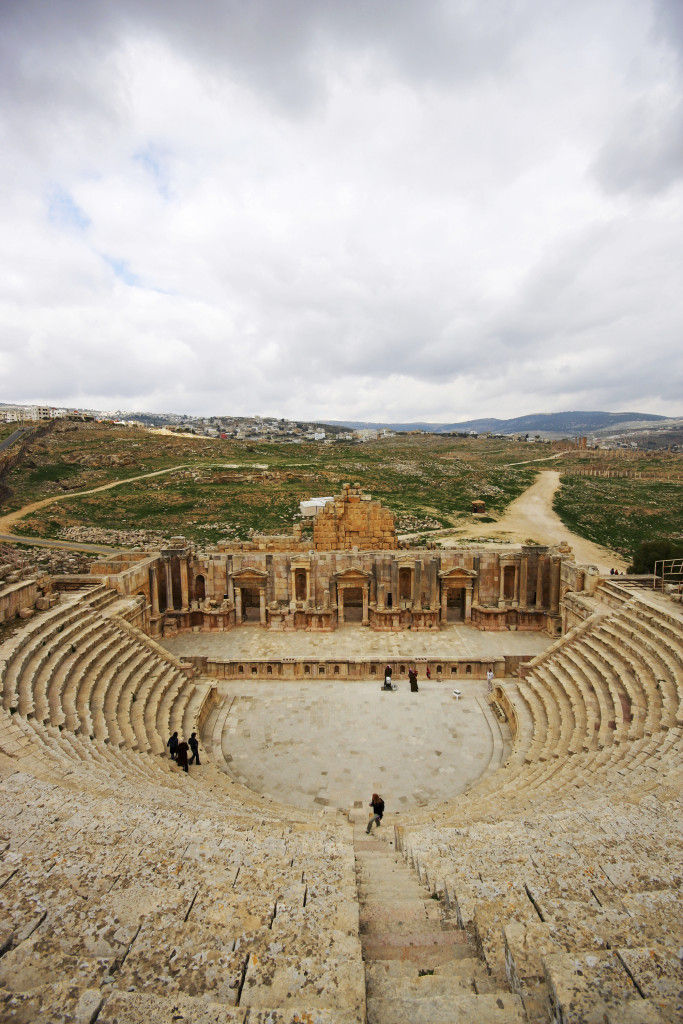
Roman Ruins of Jerash, Jordan
Similar men stood before crowds of 20,000 at the oval amphitheater in Arles, France. Blood disappeared from the theater in the 5th century, when Rome fell and the local population stormed the walls and transformed it into a full-fledged town and fortress.
But blood returned in 1830. Where gladiators once battled with harpoons and scimitars and tridents, where slaves once struggled for freedom and criminals exchanged another’s life for their own, now French matadors face off against black, long-horned bulls. The matador taunts the animal while assistants gouge and spear the bull until, exhausted by blood loss, it succumbs to the matador’s final blow. (This is a UNESCO World Heritage Site)

Arles Amphitheatre, France
At first glance, the Pompeii Spectacula looks like just another ancient Roman amphitheater, a giant stone circle of steps overgrown by grass and camera-toting tourists. It’s not.
Not only did men fight mano a mano in the arena – some voluntarily – but so did man and animal. Some credit the Roman Empire with the extinction of entire species in Northern Africa, as they rounded up thousands of lions and rhinos and elephants to be slaughtered for sport. All manner of people came to watch. Each social class had its own tunnel, entrance and seats. Canvas awnings protected the patricians and senators and their slaves.
The amphitheater was shut down twice: once because of a bloody brawl between the people of Pompeii and their Nuceria neighbors, and once because lava and ash from the Mount Vesuvius eruption entombed Pompeii for 1,500 years.

Pompeii Theatre, Italy
The Pula Arena in Pula, Croatia is one of the six largest Roman amphitheaters in the world. Today, visitors can tour the facility for approximately $1-3 USD. Visitors can pay a couple bucks for a headset to take an audio tour. In the cellar is an Archaeological Museum of Istria exhibition about ancient olive oil and wine production. Summer sees thousands of visitors gather for music concerts and film festivals. The amphitheater is open year-round.

Pula Arena in Pula, Croatia
Like most Roman amphitheaters from antiquity, the Verona Arena has a fascinating history. Built in 30 A.D. from white and pink limestone, the arena survived a 12th-century earthquake to become what it is today: an open-air opera house. Since 1913, with the exceptions of World War I and World War II, summer opera performances have been hosted every year. Yet most of Verona’s story is forgotten. There are no plaques or tour guides or museums inside its walls. But during performances, after sunset, candles distributed to the audience are lit and bathe visitors in a soft golden glow, a subtle reminder of life lived long ago.

Verona Arena, Italy
The amphitheater of at El Djem, in Tunisia, was built around the height of the Roman Empire, when emperors had the cash and the arrogance to construct 35,000-seat stadiums in far-off provinces. Reconstruction from 1974-1980 restored parts of the structure pillaged and damaged in old wars. Today, as a UNESCO World Heritage site, the red ochre amphitheater hosts seasonal events that still, in a way, accomplish its original purpose: No matter how far away the Roman Empire, by land or by time, its power still awes.

Roman Amphitheatre of El Jem