Though most people believe that the Earth will last forever, this is certainly not the case. Rising sea levels, glaciers that are melting away and the ocean becoming more acidic are all occurring right now. Unfortunately, some areas are changing and even disappearing faster than others, and some of these places may disappear or drastically change within our lifetime.
Here’s our list of top 10 Places to See Before They’re Gone
10 – Venice
It is not only the sea level rise that threatens the ancient trading city of Venice, Italy. Venice is also sinking a little bit more every year as well as slowly tilting to the east. Scientists are unsure, at this time, about what to do to prevent Venice from sinking into the mud, as it has sunk 3 feet since the 18th century.

9 – Glacier National Park
In 1850, the park had 150 glaciers, but today only 25 glaciers are large enough to be considered functional. It is predicted that by 2030, the national park will be entirely without glaciers as a result of global warming. The impact on the park’s ecosystem is expected to be high.

8 – Great Barrier Reef
The Great Barrier Reef has lost over half its coral in the last 27 years and is predicted to lose another half by 2022. Threats to the Great Barrier Reef come from pollution from nearby ports as well as destruction from agriculture such as fishing in the area. The rising ocean temperature also plays its part in the destruction of the reef. The unusually warm ocean temperatures contain less oxygen content for the corals, and they become bleached which leads to their death. The WWF predicts that if the sea temperatures continue to rise, most of the world’s coral reefs could disappear within our lifetime.

7 – The Alps
The Alps see dramatic changes nearly every time the season changes. The lack of solid ice and snow has resulted not only in a change in landscape but will also have an impact on the availability of fresh water. This is problematic as these mountains provide 40 percent of Europe’s water usage. Europe’s ski resorts have now also been forced to make artificial snow in order to keep their lifts running.

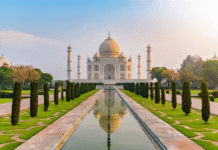
6 – Taj Mahal
The Archaeological Survey of India is considering a rule to allow visitors only a two hour entry to the Taj Mahal to help more people see the monument while also reducing the pressure caused by so much human traffic. The Taj Mahal once welcomed an overwhelming 40,000 visitors in one day.

5 – The Maldives
The Maldives are made up of over 1,100 islands, and are the lowest lying nation in the world sitting at only 1.3 meters above sea level. This means that a sea level rise of only three feet would make the islands uninhabitable for its 325,000 inhabitants. The Maldives are not even built on sand, but on corals reefs, which also face the threat of a warmer sea environment and a rising level of acidity in the ocean. The President of the Maldives, Mohamed Nasheed, says that there is only a 50-50 chance that his grandchildren will be able to live on the islands.

4 – Dead Sea
The Dead Sea is drying up. For most of its life, it has been fed from the fresh water from rivers and streams from the mountains which surround it and excess water has been evaporated naturally. This process mediated itself until the 1950s when a pump began deviating the main source of water away from the Dead Sea. The Dead Sea was 50 miles long in 1950 and 30 miles long today, which means it is decreasing at an average of three feet per year.

3 – Everglades National Park
Florida’s Everglades National Park is the largest subtropical wilderness in the United States and it is home to 68 endangered and threatened species. Yet, it has been threatened consistently by both natural and manmade disasters. It was placed on the endangered list in 1993 following damage from Hurricane Andrew and has also been recently threatened by the Gulf oil disaster, the effects of which are still unknown.

2 – Antarctica
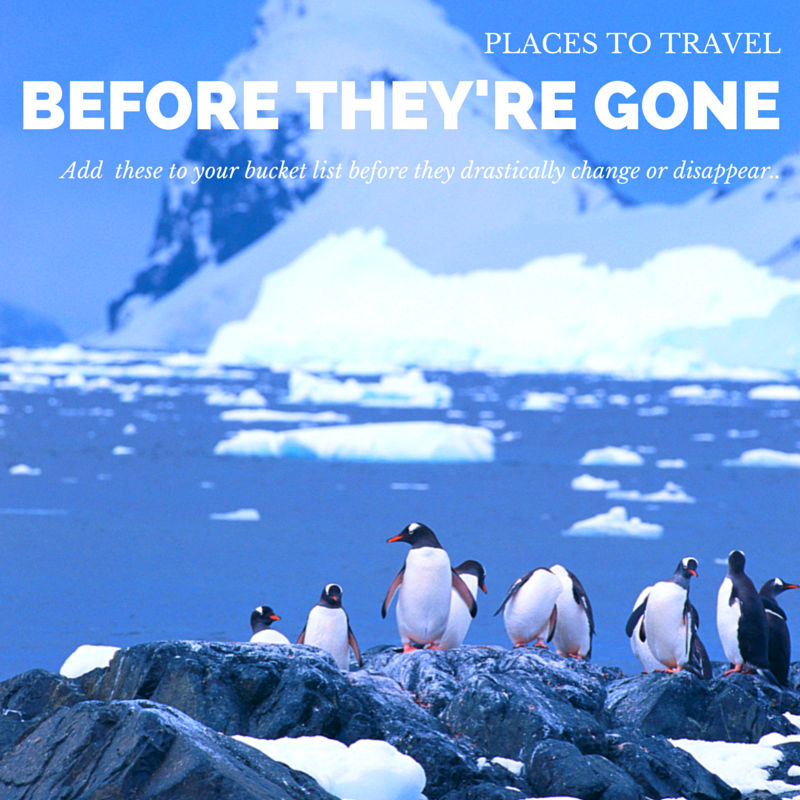
Increased tourism has had a toll on Antarctica. In 2009, 28 member countries of the Antarctic Treaty decided to limit tourism in the region to prevent further environmental damage. No boats with over 500 passengers will be allowed to dock in the region, and there will only be 100 people allowed on the ground at a time. Visitors to the region have grown seven times in the last 16 years, with Antarctica seeing as many as 45,000 people per summer season. Global warming is also having a huge impact on the region. This past March, the warmest temperature ever recorded in Antarctica was 63.5 degrees. Glaciers are melting which causes an overall rise in global sea levels. This in turn is affecting penguin colonies, and their overall numbers are dropping each year. There is also less krill in the water which is key to feeding whales and seals.

1 – Alaska Tundra
In northern Alaska, the ice arrives thinner and later every year. Many of the coastal villages have been forced to move inland because there is no longer enough ice to protect them from the increasingly dangerous coastal storms. These changes are hurting those living inland as well, with tundra lakes disappearing and local sources of drinking water going with them. Old animals are leaving and new pests are arriving, both are depleting the Eskimo’s supply of food.

Some of the world’s most remarkable places are under threat from climate change and development. Our advisors’ Bucket List Worthy Destinations guide highlights experiences worth prioritizing before they change.
Every vacation should be a meaningful experience worth the investment. Our advisors’ Ultimate PTO Hack guide maximizes both time and investment.