For all its fame as one of the world’s greatest historical and anthropological treasures, Machu Picchu certainly hasn’t been on the radar for very long—not even 100 years have passed since it was discovered in the jungles of Peru. The story of its unearthing is fascinating enough, but Machu Picchu is more than just archaeology. It’s the main character in one of the world’s most enthralling mysteries—one that is still the subject of debate after 97 years of study and analysis.
Discover why Machu Picchu was named last year as one of the New Seven Wonders of the World
Here’s what we do know about “The Lost City of the Inca”: It was constructed circa 1460, at the very height of the Inca Empire, the greatest and largest in the Americas prior to the arrival of Christopher Columbus. With the imperial capital established in nearby Cusco, what role did Machu Picchu play? Nobody quite knows. One theory is that the site is the original birthplace of the Inca people. Another postulates that it was the Empire’s economic center. Yet another conjecture is that it was a maximum-security penal colony. Most likely, it was a royal estate of Emperor Pachacuti, but its position in alignment with certain key astronomical events suggests it may have also been a religious retreat.
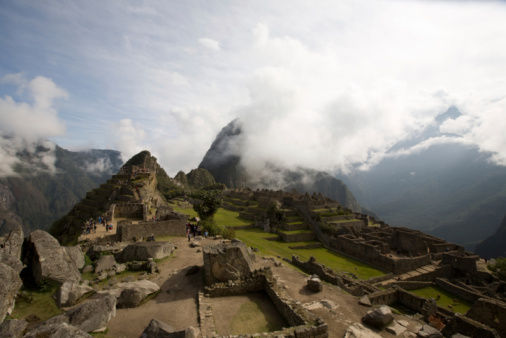
One thing is certain, however: it was placed at its location for a reason. More than 7,700 feet above sea level, Machu Picchu is nestled between two jagged, steep mountains, with a virtually impassable mountain at its rear and terraced approaches to make the treacherous inclines all the more challenging for any would-be invaders—and it worked. Sixteenth-century Spanish Conquistadores never found the site, and it faded into nothing more than a mythical rumor until 1911. It was in that year that American historian Hiram Bingham was led to the site by locals, and brought the extraordinary site back into worldwide consciousness.
As fascinating as Machu Picchu’s history is, nothing compares to the experience of taking it in with one’s own eyes. For those looking for the comfortable route to Machu Picchu, trains depart from the city of Cusco twice daily. Some of these trains feature large windows and glass ceilings that allow for astounding views of the mountain valleys and cloud forests that lead to the village of Aguas Calientes, where buses transport visitors to the actual ruins.
There is also a four-day hike to Machu Picchu down the ancient Inca access road, with buses traveling between Cusco and the trailhead. Shorter one- and two-day versions of this hike are available as well. The trek crosses ever-changing terrain and climates: sunny and warm at one point, shrouded in chilly cloud forest mists the next. Ruins of several smaller settlements—some used as ancient “motels” for Inca hikers—line the trail to the Sun Gate, Machu Picchu’s main entrance. Suddenly, spread out before you, is the entire expanse of spectacular ruins.
The finds on the other side of the Sun Gate are nothing short of astonishing. Most surprising is the unbelievably advanced design of the city—all constructed without the use of the wheel. Interconnected fountains are joined by a sophisticated water delivery system that leads to every building from distant springs. More than one hundred grand stairways are spread throughout the site, many carved in entirety from single blocks of granite. Masonry is so airtight that even a knife cannot be wedged between the stones.
The city is divided into three sections. The largely residential Popular District is comprised of thatched-roof housing. The District of the Priests and Nobility is filled with grand residences and the Monumental Mausoleum, where vaulted ceilings and walls covered in carvings honored the noble dead. The truly spectacular Sacred District is home to the infamous Temple of the Sun, just steps from the edge of a cliff overlooking a breathtaking view of the neighboring mountain valley. Nearby is the Intihuatana, a sacred stone designed as an astronomic clock and believed by the Inca to hold the sun in place. Legend says that the open-minded will see the spirit world spread out before them if they rest their foreheads against one of the stone’s smoothed surfaces. In between are gorgeous parks and sweeping walkways, all nestled within the inimitable scenery of the towering peaks of the Andes that surround the site on all sides.
All Machu Picchu tours begin and end in Cusco, the former capital of the Inca Empire that dates to the 11th century. The ruins of Inca palaces and temples are spread throughout the city, and many foundations of original Inca buildings have survived Peru’s frequent earthquakes better than their modern-day counterparts. Add to that Cusco’s restaurant scene, an innovative fusion of modern tastes with ancient flavors and methods first used by the Inca, and you have a city with a host of faces. Simply put: it’s a perfect bookend to what will be one of the most extraordinary experiences of your traveling life.
We use information collected through cookies and similar technologies to improve your experience on our site, analyse how you use it and for marketing purposes.
We and our partners use information collected through cookies and similar technologies to improve your experience on our site, analyse how you use it and for marketing purposes. Because we respect your right to privacy, you can choose not to allow some types of cookies. However, blocking some types of cookies may impact your experience of the site and the services we are able to offer. In some cases, data obtained from cookies is shared with third parties for analytics or marketing reasons. You can exercise your right to opt-out of that sharing at any time by disabling cookies.
These cookies and scripts are necessary for the website to function and cannot be switched off. They are usually only set in response to actions made by you which amount to a request for services, suchas setting your privacy preferences, logging in or filling in forms. You can set your browser to block oralert you about these cookies, but some parts of the site will not then work. These cookies do not store any personally identifiable information.
Analytics
These cookies and scripts allow us to count visits and traffic sources, so we can measure and improve the performance of our site. They help us know which pages are the most and least popular and see how visitors move around the site. All information these cookies collect is aggregated and therefore anonymous. If you do not allow these cookies and scripts, we will not know when you have visited our site.
Embedded Videos
These cookies and scripts may be set through our site by external video hosting services likeYouTube or Vimeo. They may be used to deliver video content on our website. It’s possible for the video provider to build a profile of your interests and show you relevant adverts on this or other websites. They do not store directly personal information, but are based on uniquely identifying your browser and internet device. If you do not allow these cookies or scripts it is possible that embedded video will not function as expected.
Google Fonts
Google Fonts is a font embedding service library. Google Fonts are stored on Google's CDN. The Google Fonts API is designed to limit the collection, storage, and use of end-user data to only what is needed to serve fonts efficiently. Use of Google Fonts API is unauthenticated. No cookies are sent by website visitors to the Google Fonts API. Requests to the Google Fonts API are made to resource-specific domains, such as fonts.googleapis.com or fonts.gstatic.com. This means your font requests are separate from and don't contain any credentials you send to google.com while using other Google services that are authenticated, such as Gmail.
Marketing
These cookies and scripts may be set through our site by our advertising partners. They may be used by those companies to build a profile of your interests and show you relevant adverts on other sites. They do not store directly personal information, but are based on uniquely identifying your browser and internet device. If you do not allow these cookies and scripts, you will experience less targeted advertising.

 There is also a four-day hike to Machu Picchu down the ancient Inca access road, with buses traveling between Cusco and the trailhead. Shorter one- and two-day versions of this hike are available as well. The trek crosses ever-changing terrain and climates: sunny and warm at one point, shrouded in chilly cloud forest mists the next. Ruins of several smaller settlements—some used as ancient “motels” for Inca hikers—line the trail to the Sun Gate, Machu Picchu’s main entrance. Suddenly, spread out before you, is the entire expanse of spectacular ruins.