Chinese New Year’s Eve, a day where Chinese families gather for their annual reunion dinner, is known as Chúxī, which literally means “remove evening” or “Eve of the Passing Year.” It is the longest and most important festival in China. Other countries and regions with large Chinese populations, such as Hong Kong, Thailand, and the Philippines, also celebrate the Chinese New Year. Chinese New Year, also known as the Spring Festival, is the most important holiday in China. It is a time for families to come together and celebrate the start of the lunar new year.
Chinese New Year, known as the Spring Festival, represents the most significant and culturally rich celebration in the Chinese calendar. It’s a 16-day festival steeped in ancient traditions, symbolic rituals, and deeply held superstitions designed to bid farewell to the old year and welcome the new with maximum luck, prosperity, and happiness. As we transition from the contemplative Year of the Wood Snake, we prepare to harness the unstoppable momentum and passionate energy of the Year of the Fire Horse, which commences on February 5, 2026, and concludes on February 17, 2027.
This comprehensive guide delves into the profound meanings behind the customs that have defined this holiday for millennia, updated with specific insights for the dynamic Fire Horse year. Whether you’re celebrating for the first time or are a seasoned observer, understanding these practices offers a deeper appreciation for one of the world’s most vibrant cultural events and provides practical ways to align with the auspicious energy of 2026.
The Significance of the Year of the Fire Horse
To fully appreciate the context of the 2026 celebrations, one must understand the unique astrological profile of the year. The Chinese zodiac operates on a 60-year cycle that combines 12 animal signs with five elemental forces: Wood, Fire, Earth, Metal, and Water.
The Horse’s Core Nature:
The seventh animal in the zodiac, the Horse, embodies an indomitable spirit of freedom, strength, and endurance. Historically, horses were pillars of civilization—essential for travel, agriculture, and warfare. This legacy translates into zodiac traits of independence, ambition, high energy, and an adventurous spirit. Horse years are characterized by forward motion, rapid progress, and a collective desire for advancement and exploration.
The Fire Element’s Amplification:
The element of Fire transforms and intensifies. It represents passion, dynamism, illumination, and transformation. When paired with the Horse, it creates a potent synergy. The Fire Horse Year is historically viewed as a period of extraordinary vitality, dramatic change, and powerful leadership. It encourages bold initiatives, creative expression, and decisive action. The last Fire Horse year was 1966, a year globally remembered for its cultural and social upheavals and transformations.
Cultural Keywords for 2026: Passion, Action, Speed, Visibility, Transformation, Charisma, and Courage. This is a year to gallop toward your goals, but to do so with a clear map and regular pauses to check your direction.

The Philosophical Foundation: Yin, Yang, and Auspiciousness
At the heart of all Chinese New Year traditions lies the desire to cultivate auspiciousness (吉利, jí lì). This concept goes beyond simple “luck”; it’s about aligning oneself and one’s environment with positive cosmic forces to ensure harmony, health, and prosperity.
Many rituals are built on principles of sympathetic magic (like attracting wealth by eating dumpling-shaped like gold ingots) and avoiding taboo (like not sweeping on New Year’s Day to prevent sweeping away good fortune). The festival is a massive, coordinated effort to tip the cosmic scales in favor of yang—the bright, active, and positive life force—over yin.
The color red is the ultimate symbol of this yang energy. It wards off darkness, evil spirits, and misfortune. From clothing to decorations to envelopes, red is the visual mantra of the holiday, shouting of life, joy, and prosperity.
The Pre-Festival Preparations (Days 1 to 15)
The New Year doesn’t begin with a feast; it begins with a cleanse. Preparation is a critical ritual in itself.
- The Great Annual Cleaning (扫房, Sǎo Fáng):
In the weeks leading up to New Year’s Eve, every corner of the home is scrubbed, dusted, and organized. This is not mere housekeeping; it’s a spiritual purge. The act of cleaning is believed to physically sweep away the accumulated bad luck, failures, and negative energy (huiqi) of the past year. It is psychologically powerful, creating a literal “clean slate” and making mental and physical space for the new. All cleaning tools are then put away by New Year’s Eve.
- Settling Debts and Resolving Conflicts:
Financial and emotional debts should be settled before the year turns. Starting the new year in debt is considered inauspicious, as it suggests a cycle of lack will continue. Similarly, old grudges and arguments, especially within the family, should be reconciled. Entering the New Year with a clear conscience and harmonious relationships is paramount for attracting positive qi.
- Decorating with Intent:
Once clean, the home is transformed with auspicious decorations.
• Red Couplets (春联, Chūnlián): Poetic verses written on red vertical scrolls are pasted on doorframes. They express hopes for health, wealth, and family happiness.
• Upside-Down Fu (福倒, Fú dào): The character for “good fortune” (福) is displayed upside down. The word for “upside down” (倒, dào) sounds like “to arrive” (到, dào), creating a pun meaning “good fortune arrives.”
• Door Gods: Images of fierce guardians are pasted on front doors to protect the household from evil spirits.
• Flowers and Plants: Blooming plants like plum blossoms (for resilience), narcissus (for good fortune), and pots of mandarin orange trees (for wealth) bring living, auspicious energy into the home.
The Core Celebration – New Year’s Eve & Day
This is the emotional and ritual high point of the festival.
- The Reunion Dinner (年夜饭, Nián Yè Fàn):
The most important meal of the year. Families travel great distances to gather around a table laden with symbolically charged dishes. Each item is an edible wish for the coming year. Full of traditional Lunar New Year foods
• Fish (鱼, yú): Served whole (head, tail, and body intact) to represent completeness and abundance. It is placed on the table with the head pointing toward the most respected elders as a sign of respect. The phrase “年年有余 (Nián nián yǒu yú)” means “may you have surplus year after year,” playing on the homophone for fish (yú). Also, since many fish swim in schools, they are a sign of abundance. For example, fish is often eaten because the Chinese word for fish sounds similar to the word for “surplus,” symbolizing a wish for abundance in the new year.
• Dumplings (饺子, jiǎozi): Resembling ancient Chinese sycee (gold or silver ingots), they symbolize wealth. In Northern China, families often make them together, hiding a clean coin in one. The finder is prophesied to have exceptional luck.
• Niangao (年糕): This sticky sweet rice cake signifies a “higher year” (年高, nián gāo)—promotion, growth, and rising prosperity.
• Long Noodles (长寿面, chángshòu miàn): Uncut, they represent a wish for a long life. They should be eaten without biting them shorter. Rice swells when you cook it and is said to represent luck and wealth.
• Spring Rolls (春卷, chūnjuǎn): Their golden, cylindrical shape symbolizes gold bars and wealth.
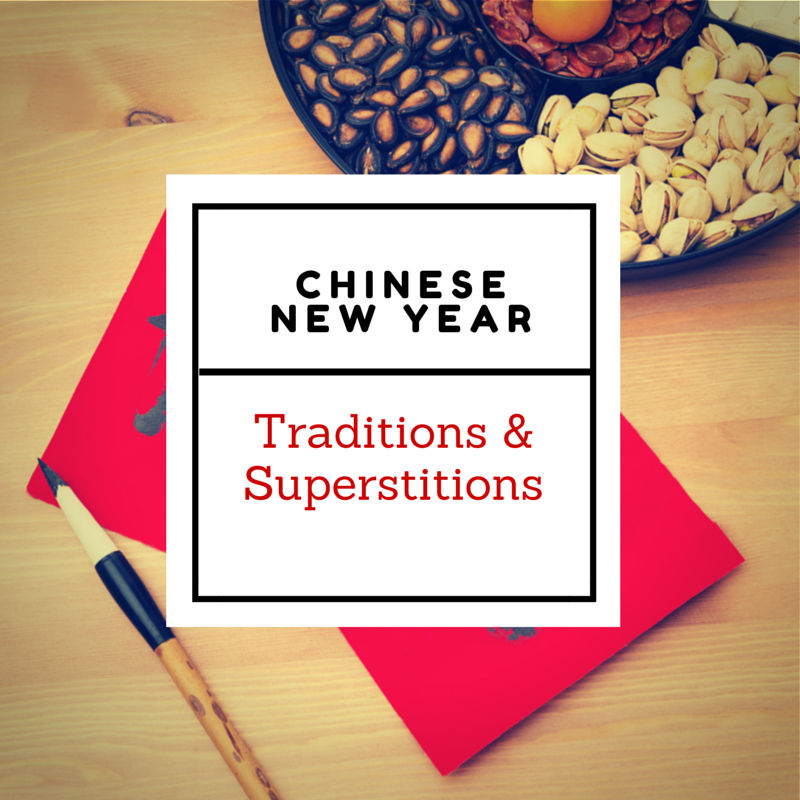
• A Tray of Togetherness (八宝盒, Bābǎo hé): An octagonal box with eight compartments filled with sweetened fruits and seeds, symbolizing a sweet and united family.
Candies, cakes, decorations, and many things associated with the New Year and its ceremonies are colored red. You will almost always find Nian Gao, which are sweet rice cakes that can be baked, fried, or steamed. Most homes also have what is called a Tray of Togetherness that has 8 compartments with sweet items such as candied melon, coconut, nuts, candy, and dried fruits. Why eight…the number 8 is considered lucky in China. - Other good ingredients to use for Chinese New Year’s dishes are oranges (signify wealth), onions (cleverness), mixed vegetables (family harmony,) egg (fertility), and pumpkin (prosperity).
- Staying Up Late (守岁, Shǒu Suì): After dinner, the family stays awake together through the night. This tradition, called “guarding the year,” symbolizes vigilantly protecting the family and ushering in the new year’s blessings. It’s a time for games, conversation, and watching the iconic CCTV Spring Festival Gala.
- The Midnight Transition:
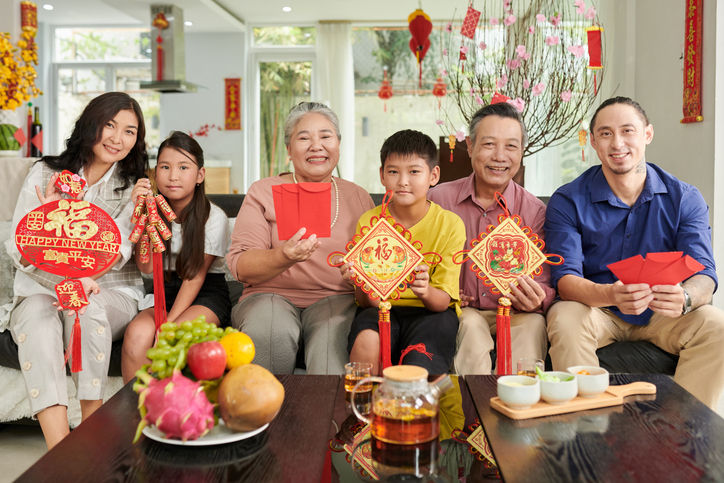
Fireworks and Open Doors: At the stroke of midnight, a cacophony of firecrackers and fireworks erupts. This explosive tradition originates from the legend of scaring away the monster Nian. Practically, it creates a joyful, yang-filled atmosphere. At this precise moment, it is customary to open all doors and windows to let the old year’s energy depart and allow the fresh, lucky qi of the New Year to flow in. - First Day Rituals: Greetings and Hongbao: On the morning of the first day, children formally greet their parents and elders with well-wishes like “恭喜发财 (Gōngxǐ fācái – Wishing you prosperity)” and “新年快乐 (Xīnnián kuàilè – Happy New Year).” In return, they receive red envelopes (红包, hóngbāo) containing “lucky money.” This act transfers blessings, suppresses the aging process (according to legend), and protects the recipient. The money must be crisp, new bills, and given in even amounts (odd numbers are for funerals). The number 8 is especially prized.
- Flowers are also important for New Years. The Chinese use mainly 2 flowers: plum blossom, which symbolizes hope and courage, and water narcissus, which represents fortune and good luck. Read more on New Year lucky flowers.
Place a bowl on your kitchen counter with oranges or tangerines – remember to keep them in even numbers. Some households put as many as 12 lucky fruits. Offer some fruit to Zao Jun, the kitchen god. Chinese mythology and folklore believe that just before the Chinese New Year, Zao Jun goes to heaven to report to the Jade Emperor. Many take a paper effigy of Zao Jun and place honey around the mouth to sweeten his words to the Jade Emperor, while others say it is to keep his lips stuck together. After this, the effigy will be burnt and replaced by a new one on New Year’s Day.

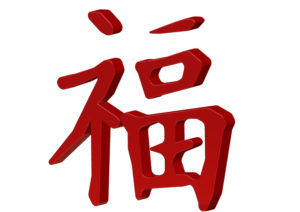
Place your Fu. Fu (pictured to the left) is the symbol for fortune or good luck in China. You will see it painted on art, wind chimes, pots, envelopes, and many other things. For New Year’s, it is customary to hang the Fu symbol on the front door or sometimes even their entrance gate.
In addition to these traditions and superstitions, there are also many other customs and activities that take place during the Chinese New Year. The Spring Festival Gala, a television show that features performances of traditional music and dance, is watched by millions of people. The lantern festival, which takes place on the 15th day of the new year, is another highlight of the celebrations.
So, what are some easy, lucky foods you can make for the Chinese New Year?
Spring rolls, dumplings, lettuce wraps, fried rice, lo mein, long noodles (mian tiao), and mustard greens are simple to make, and you can include several lucky food items.
Key Superstitions: The Do’s and Don’ts
So, what are some of the Chinese New Year Traditions and Superstitions?
Many of the Chinese New Year’s Traditions & Superstitions are similar to what we posted for New Year’s superstitions and New Year’s lucky foods here in the U.S.
Adherence to these rules is believed to directly influence one’s fortune.
What TO DO:
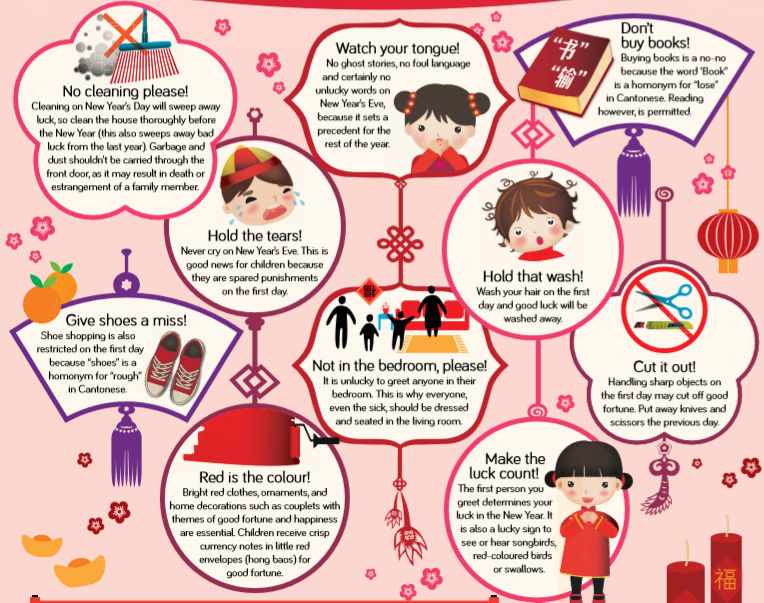
• Wear New Red Clothing: Especially on the first day, to symbolize a new, lucky start. Those born in a Horse year (your ben ming nian) should wear red all year for protection.
• Speak Only Auspicious Words: Avoid words like “death,” “sickness,” “poor,” or “broken.” If a child breaks a bowl, adults quickly say “岁岁平安 (Suìsuì píng’ān)”—”peace every year”—as “break” (碎, suì) sounds like “year” (岁, suì).
• Visit Family and Friends (from the 2nd day): The order of visits follows a strict pattern, starting with the paternal side of the family.
Even numbers Superstition: Keep things in pairs – for example, by an even number of oranges. If you give any away, give them in pairs, as odd numbers are believed to bring unhappiness.
Red Envelope: Odd amounts of money in red envelopes should be avoided as they are associated with funerals. Another important tradition is the exchange of red envelopes filled with money, known as “hongbao.” These are given to children and unmarried adults as a symbol of good luck and prosperity. It is also common for people to give gifts of food and other items to their friends and family.
What to AVOID:
• No Cleaning or Washing: Do not sweep, take out trash, or wash clothes/hair on New Year’s Day. You risk washing or sweeping away your freshly arrived good fortune. One of the most important traditions during the Chinese New Year is the cleaning of the house. This is believed to sweep away any bad luck from the previous year and make way for good luck in the new year. People also often decorate their homes with red lanterns and paper cutouts, as red is considered to be a lucky color in Chinese culture. The house is cleansed thoroughly to sweep out any bad luck and to make way for good luck in the new year. No cleaning on the first day of the year, however, as you can sweep away the luck of the new year. Washing clothes during the first two days of the New Year is believed to offend the Water God.
• No Sharp Objects: Avoid using knives, scissors, or needles. They could “cut” your wealth stream or lead to “sharp” conflicts. Using knives, scissors, or anything sharp on New Year’s Day is considered bad luck as you will “cut off” the New Year’s fortune. The yard should also be in order.
• No Crying or Arguing: Harmony is essential. A child’s tears could bring bad luck.
• No Unlucky Gifts: Clocks (送钟, sòng zhōng) sound like “attending a funeral.” Pears (梨, lí) sound like “separation” (离, lí). Handkerchiefs are associated with tears.
• A Married Daughter’s Visit: Traditionally, a married daughter does not visit her parents’ home on the first day, as it could symbolically drain the parents’ wealth and bring them misfortune. She visits on the second day or later.
Avoid taking medicine on the first day of the Lunar New Year.
Needlework should not be done during the first five days of the New Year to avoid a hard year ahead.
Visiting the hospital during the New Year can bring illness for the year, hence should be avoided.
Wearing black or white during the New Year is improper as these colors are associated with mourning.
The Fire Horse Year (2026) Specific Guidance
The general traditions are amplified by the year’s specific energy. Here’s how to tailor your approach for 2026.
- For Everyone:
• Embrace Bold Action: The Fire Horse rewards initiative. Use the New Year period to set ambitious, passionate goals. This is an excellent year to start a business, launch a creative project, or plan significant travel.
• Balance Fire with Calm: The energy can lead to impulsiveness or burnout. Incorporate grounding rituals: enjoy tea mindfully in a ceramic cup, place green plants (Wood element) in your home to nourish and temper the Fire, or practice daily meditation to maintain clarity amidst the action.
• Use Horse & Fire Motifs: Decorate with images of powerful horses, use red candles (safely), or incorporate the colors orange and gold alongside red. The phrase “马到成功 (Mǎ dào chénggōng)”—”May success come as swiftly as a galloping horse”—is the perfect greeting for 2026. - For Those Born in a Horse Year (Your Ben Ming Nian):
If you were born in 1954, 1966, 1978, 1990, 2002, or 2014, 2026 is your zodiac year. Traditionally, this is considered a potentially challenging year where your guardian animal is “away,” leaving you more vulnerable. To navigate this:
• Wear Red Consistently: Red underwear, socks, bracelets, or accessories are worn throughout the year for protection.
• Exercise Caution in Major Decisions: Be extra thorough, avoid reckless risks, and be mindful of health. - Feng Shui Adjustments for 2026:
• Activate the South: The South is associated with the Fire element. Enhance this area of your home or office with red decor, lights, or an image of a strong horse to harness the year’s positive energy.
• Introduce Water Elements: To prevent the Fire from becoming too overwhelming, place a small tabletop fountain or a bowl of water in the North area of your space to create balance.
• Clear Clutter: Especially in hallways and near doors, to allow the Horse’s energy (and your opportunities) to move freely into your life.
Specific Insights & Actions for the Year of the Fire Horse (2026)
Beyond general traditions, each zodiac year carries its own nuances. Here’s how to personally connect with and navigate the unique energy of the 2026 Fire Horse.
Understanding the “Fire Horse” Personality & Its Historical Weight
- The Fire Horse (丙午, Bǐng Wǔ) is considered the most powerful and intense of all Horse combinations in the 60-year cycle. In Chinese folklore, it’s sometimes called the “Wild Horse” or “Heavenly Horse,” known for its indomitable spirit and difficulty being tamed.
• Cultural Reference: The last Fire Horse year was 1966. A quick look at global events from that year—a time of massive social upheaval, cultural revolution, and bold movements—illustrates the transformative, “burning down the old” energy associated with this sign. Mentioning this provides historical context.
• For Those in a Relationship with a Horse-born: Understanding that Horse individuals (especially Fire Horses) value freedom, adventure, and direct communication is key. They are inspired by partners who have their own passions and goals. - Career & Financial Strategy for a Fire Horse Year
The Horse’s energy favors momentum, but Fire can lead to impulsivity. Offer grounded advice:
• Ideal Ventures: Industries aligned with speed, travel, innovation, and visibility will thrive. Encourage readers to consider projects in tech startups, logistics, sports, marketing, public relations, or the arts. It’s an excellent year to “put yourself out there.”
• Financial Caution: The phrase “strike while the iron is hot” applies, but so does “don’t burn your capital.” Advise against get-rich-quick schemes. Instead, recommend investing in self-education, quality tools, or building a personal brand—investments that fuel sustainable momentum.
• Networking Tip: Horses are social creatures. The energy of 2026 favors conferences, industry meet-ups, and collaborative projects over solitary work. Encourage readers to “gallop” into new professional circles. - Travel & The Fire Horse: A Perfect Alignment
- The Horse is the ultimate symbol of travel and exploration. This should be a major theme for a travel blog.
• Auspicious Travel Directions: Based on annual Flying Star Feng Shui (which changes each year), you can note that for 2026, the Southeast is associated with the “Traveling Horse” star, making it an auspicious direction for journeys that lead to growth and opportunity. (Note: You should verify the precise 2026 Feng Shui charts closer to the date for accuracy, but the concept is highly relevant.)
• Type of Travel: Encourage adventurous, active, or culturally immersive trips over passive beach holidays. Horseback riding tours, hiking expeditions, road trips, or visiting historical trade route cities (channeling the Horse’s ancient role) are perfectly themed.
• Travel Timing: Suggest that planning trips after the first 15 days of the New Year is ideal, as it aligns with the Horse’s “moving forward” energy once the family-centric rituals are complete. - Health & Wellness Alignment with Horse Energy
- In Traditional Chinese Medicine, the Horse is linked to the Heart and Small Intestine meridians and the Fire element.
• Key Advice: The Fire Horse’s intense energy can manifest as stress, heart palpitations, insomnia, or burnout. Recommend practices that cool and ground the Fire:
• Foods: Incorporate cooling, hydrating foods like cucumber, watermelon, mint, celery, and barley in festive meals.
• Activities: Balance high-energy pursuits with calming rituals. Suggest Tai Chi or Qigong, which marry movement with mindfulness—perfect for the Horse’s need for action and the requirement for inner calm.
• Rest: Emphasize that in a year of urging constant movement, scheduled rest is not laziness; it’s essential maintenance to prevent the “fire” from burning out. - Unique Gift-Giving Ideas for the Horse Year
Move beyond standard hongbao advice with themed gifts:
• For the Home: A sculpture or high-quality print of a powerful horse, preferably in red or gold. A decorative horsehair whisk (a historical symbol of authority) or a vintage map celebrating ancient trade routes.
• For Personal Wear: Jewelry featuring horse motifs (pendants, bracelets) or the Chinese character for horse (馬). Red agate or carnelian stones are perfect as they match the Fire element.
• For the Traveler: A quality compass (guiding the Horse’s journey), a leather travel journal, or a subscription to a travel-related service. Frame the gift with the wish that their travels be “smooth and successful” (一路顺风, Yīlù
The Festival’s Conclusion: The Lantern Festival
The 16-day celebration culminates on the 15th day of the first lunar month with the Lantern Festival (元宵节, Yuánxiāo Jié). This marks the first full moon of the new year. Communities gather to admire elaborate lantern displays, solve riddles written on lanterns, and eat tangyuan (sweet glutinous rice balls). These round, sweet balls symbolize family unity and completeness, offering a final, sweet wish for togetherness as the festive period closes.
Chinese New Year is more than a holiday; it’s a profound, collective ritual of renewal. Every cleaned house, every symbolic dish, every red envelope, and every avoided taboo is a thread in a vast, living tapestry of hope, connecting the present to ancient wisdom. As we enter the dynamic and passionate Year of the Fire Horse 2026, these traditions offer a roadmap—not just for celebrating, but for actively shaping a year of courage, progress, and auspicious fortune. By understanding and participating in these practices, we honor a rich cultural heritage and align ourselves with the universal human desire for a brighter, more prosperous beginning.
From all of us at Atlastravelweb.com, we wish you and your family a New Year filled with vibrant health, abundant joy, and resounding success.
Other posts that may interest you:
New Year’s Lucky Foods
Lucky Food Recipes for New Years
What not to Eat on New Year’s Day
New Years Lucky Colors
New Years Lucky Soups
Chinese New Year is a time when age-old superstitions are observed by households as festive customs & traditions.
If you are interested in superstitions, we have plenty of blog posts with fascinating superstitions from the Super Bowl, holidays, Friday the 13th, and more.
Chinese New Years Superstitions & Traditions
Strange Superstitions Around the World
Friday the 13th Bad Luck Superstitions
St. Patrick’s Day Superstitions
Super Bowl Traditions & Superstitions
Christmas Superstitions
Coin Superstitions Around the World
Eye Twitching Superstitions
Evil Eye Symbol Meaning