
April Fools Day sparks joy worldwide: pranks that test gullibility, superstitions that whisper warnings, traditions that unite strangers in laughter. On this unofficial holiday, April 1st becomes a playground for mischief, blending ancient rituals with modern memes. Whether you’re plotting a hoax or visiting festival sites, understanding its roots reveals why travelers love it. (April is one of the most interesting months for unusual celebrations — see our roundup of the most unusual festivals around the world in April.) From Roman disguises to French fish, dive into origins, beliefs, and global twists, plus tips to experience it on your next trip.
The term ‘fooles holy day’ was an early reference to April Fools’ Day, mentioned in 1686 by antiquarian John Aubrey, highlighting its historical significance in the context of practical jokes and evolving traditions.
The Mysterious Origins of April Fools Day
No single tale explains April Fools Day, but theories weave a tapestry of springtime folly. One points to ancient Rome’s Hilaria festival, honoring goddess Cybele with costumes, mock trials, and role reversals (source: Ovid’s Fasti, via Perseus Digital Library). Celebrated near equinox, it mirrored nature’s tricks: unpredictable weather fooling farmers.
Another link to Europe’s calendar chaos. When nations shifted from Julian to Gregorian systems, those clinging to April 1st as New Year’s became prank targets, dubbed fools for their delay (detailed in History.com’s calendar explainer). In France, hoaxers stuck paper fish on backs, calling them “poisson d’avril” (April fish: naive and easy to hook).
Early records include a Flemish poem of a servant’s absurd errands and Chaucer’s Canterbury Tales hinting at March folly (source: British Library manuscripts). By the 17th century, John Aubrey noted it as “fooles holy day” in folklore notes. The custom sailed to American colonies via newspapers’ fake tales, evolving into today’s corporate spectacles. These threads, from Egyptian myths adopted by Rome to medieval feasts, show cultural mash-ups fueling the fun.
History of April Fools Day
No one knows for certain how April Fools’ Day started. One theory ties it to the arrival of spring — communities that observed April 1st as the first day of the new season developed playful traditions around nature’s own unpredictability. Another theory points to the calendar: in some regions, April 1st was still celebrated as New Year’s Day long after the official date changed. Those who stuck to the old date were mocked as fools.
In 1582, the shift from the Julian to the Gregorian calendar created widespread confusion. Many people didn’t get the news that the new year had moved to January 1. They kept celebrating around April 1 instead — and became targets of pranks. In France, pranksters stuck paper fish on their backs and called them “poisson d’avril” (April fish) — as easy to catch as the gullible people they were.
Another theory points to the Roman festival of Hilaria — meaning “cheerful times” — held each spring in honor of the goddess Cybele. Participants wore disguises and mocked their fellow citizens. The festival’s roots stretched back to Egyptian mythology, which Rome absorbed as its empire expanded.
By the late Middle Ages, the tradition of spring foolery was taking recognizable shape across Europe. Geoffrey Chaucer’s Nun’s Priest’s Tale includes a line hinting at events “since March began” — which some scholars link to April 1, though the interpretation remains debated.
By the 18th century, April Fools’ Day had spread throughout Britain, and from there to the American colonies. The tradition was well established by the 19th century, with newspapers regularly printing false stories on April 1st to fool their readers.
April Fools Day Superstitions – Superstitions to Know (And Debunk)
Superstitions add spice, warning against bad luck amid the laughs. Most stem from folklore, not fact; treat them as cultural curiosities for your travels.
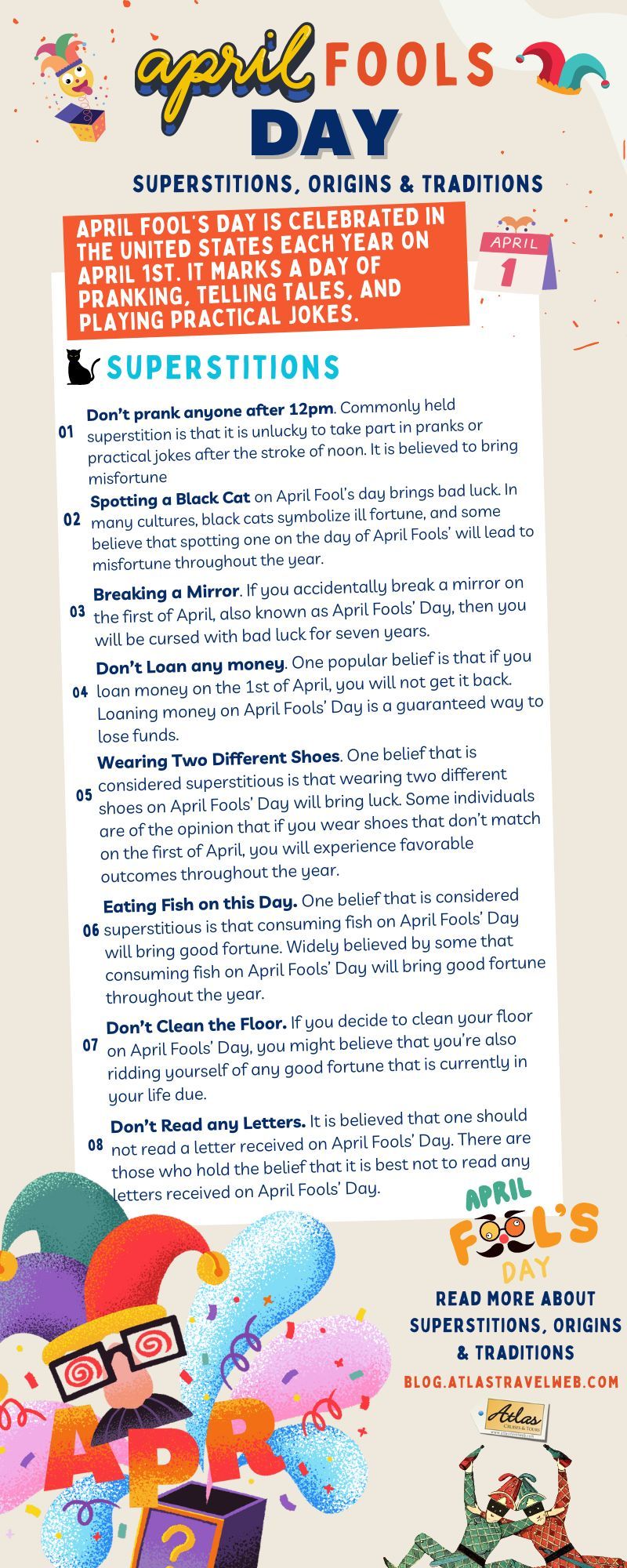
Don’t prank anyone after 12pm. In the UK, pranks after noon curse the joker: tradition holds that post-midday mischief rebounds, making you the fool (rooted in 18th-century prints, per English Heritage folklore). Shout “April Fool!” before noon to stay safe.
Being pranked brings bad luck. This superstition holds that being fooled on April 1st invites misfortune for the rest of the year. The logic: foolishness attracts bad luck. No evidence supports it. Treat it as colorful folklore, not a genuine threat.
Spotting a black cat on April 1st brings bad luck. Black cats are considered unlucky in many traditions. On April Fools’ Day, that association gets amplified by the holiday’s mischievous energy. No science supports it — but it makes a great story to share on the road.
Changing your name on April 1st invites misfortune. Taking a significant life decision on a day ruled by trickery is seen as asking for trouble. Some traditions warn that the mischievous spirits active today might permanently muddle your new identity. Save the name change for April 2nd.
Breaking a mirror on April 1st doubles the bad luck. The standard mirror-breaking curse runs seven years. On April Fools’ Day, folklore warns it could stretch to fourteen. Unlucky timing or unlucky twice over — either way, handle with care today.
Don’t loan money on April 1st. The spirit of trickery ruling this day ensures borrowed money never returns. Lending on a day built around deceit makes you the fool. This caution appears in folk traditions from India to Italy — a remarkably consistent piece of cross-cultural financial wisdom.
Wearing two different shoes brings good luck. Mismatched shoes on April 1st are said to confuse bad spirits. Throw them off your scent and you’ll sail through the year. The tradition reportedly started in England with mismatched socks. Small price for a lucky year.
Eating fish on April 1st brings good fortune. This belief is especially strong in Italy and France, where fish carries symbolic weight tied to the zodiac sign Pisces and the spring fishing season. The connection to the French “poisson d’avril” (April fish) tradition makes this one superstition with a clear cultural origin story.
Don’t sweep the floor on April 1st. Put down the broom. Sweeping on April Fools’ Day is said to brush out any good fortune residing in your home. This belief echoes a similar superstition around Chinese New Year — in both traditions, sweeping at the wrong moment risks cleaning out your luck along with the dust.
Don’t read letters (or emails) received on April 1st. Any correspondence arriving on this day might be a prank. Better to wait until April 2nd to open it. In the modern version, this extends to emails and text messages — treat unexpected messages today with appropriate skepticism.
Must prank at least once? Some say skipping tribute invites woes, honoring the holiday’s essence.
Don’t Carry out a practical joke. One belief held as superstition is that if you do not carry out a practical joke on April Fools’ Day, ill fortune will come your way. Some traditions suggest that playing at least one prank ensures good fortune for the rest of the year, as you’ve paid proper tribute to the spirit of the day.
The First Day of Mischief
The first recorded reference to April Fools’ Day is found in a 1561 Flemish poem by Eduard De Dene, which describes a nobleman sending his servant on a series of absurd errands. This poem is often cited as the earliest known example of an April Fools’ Day prank, showcasing the long-standing tradition of fooling others.
The custom gained popularity in England in the 17th century, with the first mention in John Aubrey’s book “Remaines of Gentilisme and Judaisme” in 1686. By the 18th century, the holiday had crossed the Atlantic and was known in America, with references appearing in newspapers and diaries.
One of the earliest documented April Fools’ pranks in America occurred in Boston in 1789, when a newspaper invited people to watch the washing of elephants at a local address, which turned out to be the home of a prominent citizen who was not amused by the crowds that gathered.
These early mentions highlight the enduring appeal of April Fools’ Day pranks and the joy of playful deception that has transcended cultures and centuries.
How April 1st Is Celebrated Around The World
United States: In the United States, individuals usually shout “April Fools!” when they pull off a practical joke. Pranks range from simple household tricks to elaborate corporate hoaxes. Major companies like Google, Netflix, and Amazon have become known for their annual April Fools’ Day product announcements and jokes.
United Kingdom: In the United Kingdom, pranks are only acceptable in the morning and anyone who pulls off an April Fool’s Joke after that is considered to be a fool. The cutoff is traditionally noon, after which the prankster becomes the fool. British media outlets often participate with fake news stories designed to catch readers off guard.
Scotland: In Scotland, their version of April Fool’s Day is called “Hunt The Gowk Day” and involves sending someone on a prank-filled errand or sending them back and forth. This tradition of ‘fool’s errands’ has historical significance, often serving as a playful initiation for newcomers. “Gowk” is Scottish for cuckoo, a symbol of foolishness. The day is followed by Tailie Day, which involves pranks focused on the posterior, such as attaching fake tails or “kick me” signs to people’s backs.
France and Italy: In France and Italy, they refer to the holiday as April Fish Day or “Poisson d’Avril” in French and “Pesce d’aprile,” in Italian. They tape a paper fish to another person’s back and scream “April Fish.” Fish are a lucky symbol in many cultures — from the Chinese New Year feast to Irish fishing traditions. This tradition dates back to the 16th century and may relate to the zodiac sign Pisces, which falls just before April, or to the abundance of newly hatched fish, which were considered easy to catch, like gullible people. For more on lucky symbols from around the world, see our guide to good luck charms from around the world.
Germany: Germans’ April Fools Day is known as “April-Scherz,” which means “April joke.” German media often participate enthusiastically, with elaborate hoaxes. One tradition involves telling someone that their shoelace is untied (even if they’re wearing slip-ons). Children often enjoy playing “April, April!”
Brazil: In Brazil, the day is called “Dia da Mentira,” which means “Day of Lies” and people make up outrageous lies or fake announcements. The Brazilian media participates actively, and the tradition has roots dating back to 1828 when a newspaper published a false announcement about the death of Emperor Dom Pedro I.
India: The festival of Holi, while not directly related to April Fools’ Day, shares similar elements of mischief and occurs around the same time of year. Modern urban Indians, particularly the younger generation, have embraced the Western tradition of April Fools’ pranks.
Sweden: April Fools’ Day or “Aprilsnarr” is marked by newspaper hoaxes and practical jokes. One famous prank involves the BBC’s 1957 broadcast about a supposed Swiss spaghetti harvest, illustrating how well-executed pranks can capture public attention.
Japan: In Japan, April Fools’ Day was introduced in the late 20th century and has been embraced particularly by corporations and the media. Japanese companies often release fake products or services, and the day has become a marketing opportunity. If you love exploring how different cultures celebrate with superstitions and traditions, our guide to Chinese New Year traditions and superstitions explores some of Asia’s most fascinating festive customs.
The Impact of Technology on April Fools’ Day
Technology has transformed April Fools’ Day from a neighborhood prank into a global spectacle. Social media platforms amplify hoaxes in minutes. Online news outlets and brands now compete to publish the most creative fake stories. The scale of deception is bigger than any previous century could have imagined.
Social media platforms like Twitter, Facebook, and Instagram have become hotbeds for April Fools’ Day pranks, with users sharing fake announcements, digitally altered images, and elaborate hoaxes that can quickly go viral. Tech companies have embraced the tradition, with Google in particular becoming famous for its annual April Fools’ Day product announcements, such as Google Nose (which claimed to offer the ability to search by smell) and Gmail Paper (a service that would print and mail your emails).
However, this has also led to concerns about the blurring of lines between fact and fiction, with some people struggling to distinguish between genuine news and April Fools’ Day hoaxes. The spread of misinformation and “fake news” has made some organizations more cautious about participating in April Fools’ Day pranks, particularly when it comes to serious topics like health, finance, or politics.
Digital pranks have evolved beyond simple hoaxes to include more interactive elements, such as fake virus warnings, website takeovers, and app-based pranks. The anonymity and reach of the internet have also led to some pranks crossing the line from harmless fun to cyberbullying or scams, prompting calls for more responsible pranking.
As technology continues to evolve, so too does the nature of April Fools, making it a day where skepticism and humor go hand in hand, and where the boundaries between reality and fiction are increasingly blurred.
April Fools’ Day in Popular Culture
April Fools’ Day has left its mark on popular culture for generations. Films, TV shows, and novels have used it as the perfect backdrop for mischief, mistaken identity, and chaos. In the social media era, it has become a competitive sport — brands, celebrities, and regular people vie for the most creative, most shared prank of the day.
In film, April Fools’ Day has been the central theme in movies like the 1986 horror film “April Fool’s Day” and has featured prominently in comedies like “Ferris Bueller’s Day Off,” where the protagonist’s elaborate school-skipping scheme takes place on April 1st. Television shows like “The Office,” “Friends,” and “The Simpsons” have all featured memorable April Fools’ Day episodes where characters prank each other to hilarious effect.
In literature, April Fools’ Day has appeared in works ranging from children’s books like “It’s April Fool’s Day!” by Steven Kroll to more adult fare like Joseph Heller’s “Catch-22,” which features an April Fools’ Day prank gone wrong. The holiday has also inspired numerous joke books and prank guides.
In addition, many brands and companies have used April Fools’ Day as a marketing opportunity, creating fake products or services to promote their brand and engage with their audience. From Burger King’s “Left-Handed Whopper” to Amazon’s “Petlexa” (a version of Alexa for pets), these corporate pranks have become a cultural phenomenon in their own right.
Music has also embraced the holiday, with songs like “April Fools” by Rufus Wainwright and comedy albums released on the day. Comedy and improv groups often hold special April Fools’ Day performances, and many comedy clubs consider it one of their biggest nights of the year.
From hilarious movie scenes to viral internet pranks, April Fools’ Day continues to inspire creativity and laughter in popular culture, cementing its status as a day of humor and mischief in the collective consciousness.
Famous April Fool’s Day Jokes
A famous millionaire named Dick Smith decided to auction off Antarctic icebergs in 1978. He told people that by breaking pieces of the iceberg off and placing them in their drinks that it would freshen the taste of their beverage. It turns out that the “iceberg” that Smith was auctioning off was actually just shaving cream and a bunch of fire extinguisher foam that was covered up on a barge. The prank gained international attention and highlighted environmental issues years before climate change became a mainstream concern.
In 1957, the news program Panorama told listeners that because Switzerland had a very mild winter and no spaghetti pests, they were actually able to grow spaghetti. They urged individuals to put a piece of spaghetti in a container of tomato sauce, and it would grow. The BBC received hundreds of calls from viewers asking how they could grow their own spaghetti trees, and some even reported success with their “plantings.”
In 1962, the only television station in Sweden told viewers that their black-and-white TV shows could actually be seen in color if they cut up an old pair of stockings and placed them over their TV screen. Many viewers were disappointed when they realized that it was just an April Fool’s Day prank. The station demonstrated the “technique” by having a technical expert explain how the nylon’s mesh would “bend light” to create color images.
In 1976, a radio station called BBC Radio 2 got in on the April Fool’s Day fun by telling listeners that at 9:47 a.m., the earth would lose its gravity, and they would be able to float if they jumped in the air. Despite the fact that it was a hoax, many people did report that they had actually floated. Astronomer Patrick Moore, who announced the planetary alignment causing this phenomenon, added credibility to the prank.
In 1980, the BBC told its citizens that the world-famous Big Ben clock would be modernized by converting it to digital. This resulted in many outraged citizens and a few people from Japan actually bidding for the clock’s hands. The announcement included details about how the historic hands would be given away as souvenirs to the first four callers.
National Public Radio ran a memorable April Fool’s Day prank in 1992, featuring an actor impersonating former President Richard Nixon claiming he was running for president again with the slogan “I didn’t do anything wrong, and I won’t do it again.” Many listeners believed the story and called in to express their outrage before the station revealed the hoax.
In 1996, Taco Bell took out full-page ads in seven major U.S. newspapers announcing that it had purchased the Liberty Bell to help reduce the national debt and renamed it the “Taco Liberty Bell.” The White House got in on the joke, announcing that they had also sold the Lincoln Memorial to Ford Motor Company, which would be renamed the “Lincoln Mercury Memorial.”
In 1998, Burger King introduced the “Left-Handed Whopper,” specially designed for left-handed customers with all condiments rotated 180 degrees. Thousands of customers requested the special burger, and many others specifically asked for the “right-handed” version.
In 2015, Amazon announced “Amazon Dash,” a button you could press to automatically order products like laundry detergent. Many thought it was an April Fools’ joke, but it turned out to be a real product, demonstrating how the line between April Fools’ pranks and actual innovations can sometimes blur.
In 2019, Google announced “Google Tulip,” a feature that would allow users to communicate with plants using Google Home. The elaborate prank included fake research and testimonials from “plant scientists” and showcased the company’s commitment to creative April Fools’ Day pranks.
Various notable April Fools’ pranks have been carried out by media and corporations, showcasing the humorous spirit of deception. The tradition of reporting outrageous fictional claims during April Fools’ Day has led to many elaborate hoaxes, such as fabricated news stories and absurd advertisements, which have become an anticipated part of the holiday’s celebration.
April Fools’ Day is one of the few holidays that crosses every cultural border — from ancient Rome to modern social media, the impulse to play and be played is universal. For more holiday folklore worth exploring on your travels, see our guide to St. Patrick’s Day superstitions and traditions. Whatever you believe, one thing is certain on April 1st: stay sharp, trust nothing, and laugh at everything.
More Holiday Traditions, Superstitions & Celebrations from The Traveler’s Atlas:
- St. Patrick’s Day Superstitions, Traditions & How to Celebrate
- Good Luck Charms from Around the World
- Chinese New Year Traditions and Superstitions
- Friday the 13th Superstition: Interesting Facts and Myths
- Easter Traditions from Around the World
- How Valentine’s Day is Celebrated Around the World
More Festivals and Seasonal Travel from Our Advisors:
- Chinese New Year 2022 – Year of Tiger Zodiac Predictions
- Travel Resolutions for 2022
- How To Celebrate Easter At Home
- Virtual Christmas Tree Lightings & Holiday Lights Displays
- How To Watch Hallmark Christmas Movies Without Cable
- How To Get A Free Thanksgiving Turkey
- Thanksgiving Meals To Go 2020
- Virtual 4th of July
More Special Events and Cultural Travel:
- What Kind Of Traveler Are You?
- The Bermuda Triangle
- The Best Places To See An Outdoor Movie
- Most Useful Airline Apps
- The Worst Cities for Travelers to Drive In
- Disney Cruise Line to Visit Canada & Bermuda in 2018
- Historic Battles Reenacted
- The Worst Seats On An Airplane
More Seasonal Events:
More Family Travel Planning:
- Father’s Day Gifts For the Traveling Dad
- Travel With Babies: The Basics
- Luxury Family Travel Ideas
- Indoor Water Parks for Fall and Winter Fun
- Fun Family Trips in Eastern Pennsylvania
- Fabulous Fall Festivals
- Walt Disney World: Enjoy Smaller Crowds (and Great Deals) in Fall 2012
- Orlando: More Than Amusement Parks
More Unique Travel Experiences:
- Best Burgers in America
- The Best Movie Theaters in America
- When Your Teen Wants to Travel Internationally
- Tips on Visiting Cemeteries
- What Not to Forget When Packing for a Camping Trip
- Dream Jobs for Travelers
- Genealogical Travel: Discovering Your Roots
- Golf Vacation Destinations
More Special Events:
More Seasonal Holiday Travel:
- Winter Wonderlands Throughout The World
- St. Nicholas Day
- The Best Places To See Christmas Lights
- Where To See The Nutcracker
- Christmas Tree Lightings Around The Country
- 2013 Lighting of the Rockefeller Christmas Tree
- Black Friday Shopping Destinations
Organizing a Music or Entertainment Group Cruise?
DJs, promoters, radio personalities, and event brands trust Atlas Travel Center to run their group cruise experience. You sell the cabins and build the brand — we handle the ship contract, payment plans, and onboard logistics. Earn a free comp berth for every 16 guests, plus build your own markup into the price. Explore our Music & Entertainment Group Cruise program and see how we make your event profitable.
Planning a Black Group Travel Experience, HBCU Trip, or Greek Cruise?
Atlas Travel Center has deep expertise in Black group travel — from HBCU alumni cruises and Greek organization trips to affinity group experiences and cultural travel. We build fully branded group experiences where your organization leads and we run the back office. Comp berths, payment plans, and trust architecture that your members can count on. Learn about our Black Group Travel & Affinity Group program — contact us to get started.