
What Travelers Should Actually Know
If you have been watching the news this week, you have likely seen the words “hantavirus” and “cruise ship” appear in the same headline. If your first reaction was to think about that vacation you have been planning, the sailing you already booked, or a dream trip you were considering for next year, you are not alone. As travel advisors, we have been on the phone steadily with clients who want to talk this through. We thought it might help to share, in one place, the kind of conversation we have been having with our own travelers, the perspective we wish more people could hear, and the practical guidance that might actually be useful.
A Quick Note Before We Continue
We are travel advisors, not doctors, and this post is not medical advice or specific travel advice for your situation. Health questions belong with your physician, and questions about your particular booking belong with us, by phone or email. What we can offer here is what we are seeing in our industry, what we are reading from public health sources, and the kind of common-sense framing we share with our own clients. If you take only one thing from this post, let it be this: good information is the antidote to anxiety, and you deserve good information.
What Has Actually Happened
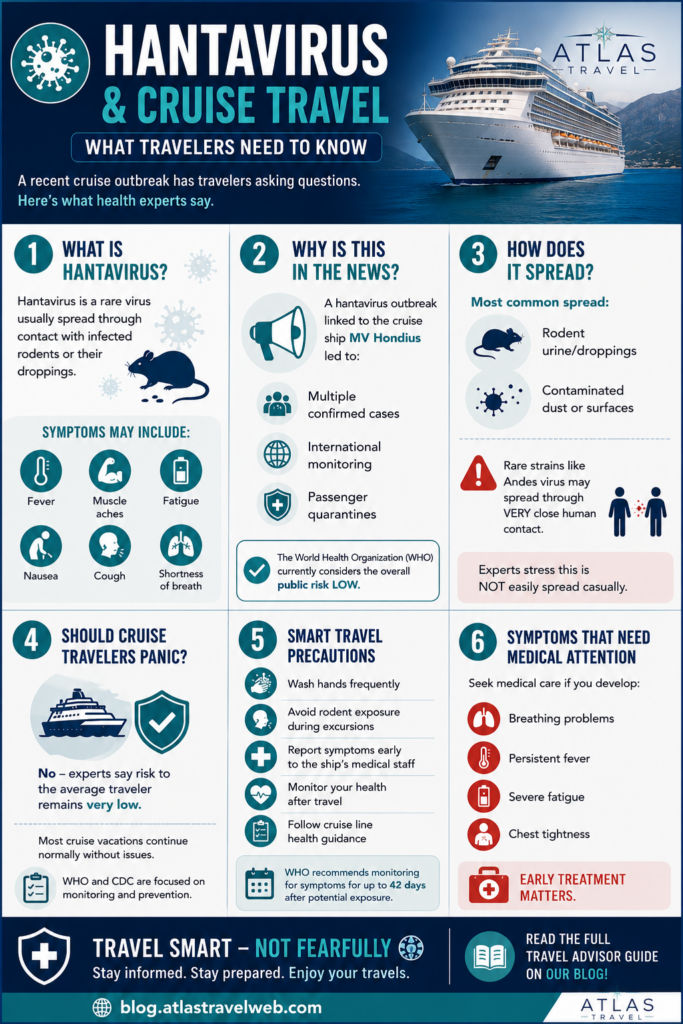
In early April 2026, the MV Hondius (a small Dutch-flagged expedition ship operated by Oceanwide Expeditions) departed Ushuaia, Argentina, with 147 people aboard, including 86 passengers and 61 crew from 23 different countries. It was on a multi-week itinerary through some of the most remote places on the planet: Antarctica, South Georgia Island, Tristan da Cunha, Saint Helena, and Ascension Island. Several weeks into the voyage, a cluster of severe respiratory illness emerged, prompting notification to the World Health Organization on May 2. As of this writing, investigators have identified eight cases (six confirmed and two suspected), with three deaths.
The strain involved is the Andes virus, a hantavirus found primarily in South America. Public health investigators believe the original exposure happened on land, likely during a bird-watching trip the first two cases took through Argentina and neighboring countries before they boarded the ship. People typically catch hantavirus through contact with infected rodents (their urine, droppings, or saliva). The Andes strain also holds a unique distinction: it is the only hantavirus that can spread from one person to another, and even then, only through close, sustained contact.
The World Health Organization has publicly assessed the global public health risk as low. The CDC says the risk to the broader public in the United States is extremely low. Containment efforts have been thorough, multinational, and coordinated, and the ship is now docking in Tenerife so passengers can be repatriated under medical supervision.
That is the news in plain language. Now let us talk about what almost nobody else seems to be saying clearly.
The Most Important Thing the News Is Not Saying: Expedition Cruising Is a Different Animal
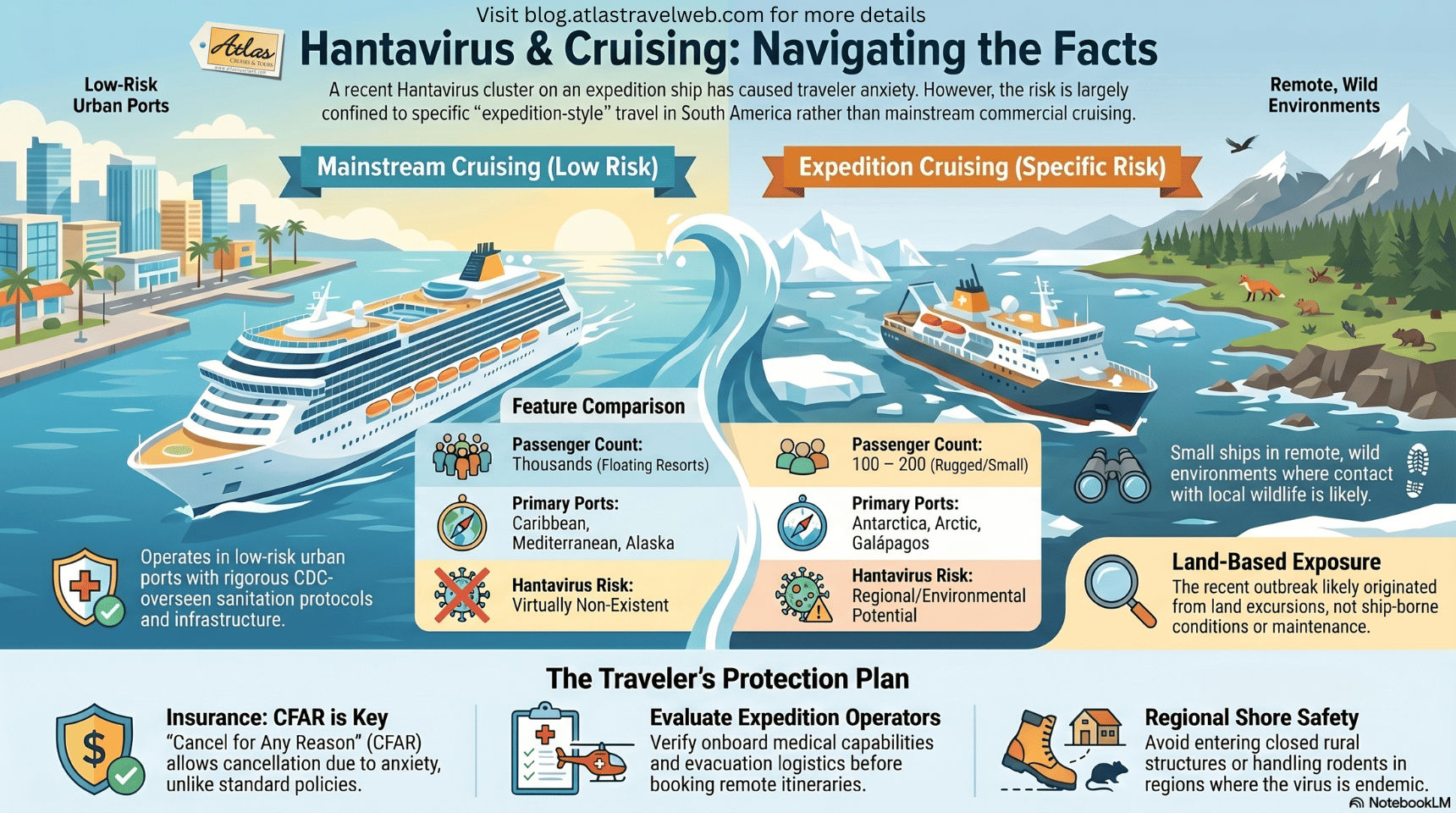
When most travelers hear “cruise ship,” they picture a multi-thousand-passenger floating resort: pools, water slides, casinos, multiple dining rooms, Broadway-style shows, and ports of call in the Caribbean, the Mediterranean, or Alaska. That is mainstream cruising, and it is what the vast majority of travelers book.
Expedition cruising is something different. Expedition ships are small (often 100 to 200 passengers, sometimes fewer), built to reach places mainstream ships cannot go: Antarctica, the high Arctic, the Galápagos, remote Pacific islands, the Northwest Passage. The experience is more rugged, more naturalist-led, and more weather-dependent. Passengers tend to be experienced travelers chasing a trip that feels truly off the map. Onboard medical facilities are smaller than on a mega-ship. Evacuation logistics are far more complex (you might be days from a port that even has an airport). The itineraries themselves include shore excursions in places where the local environment, including wildlife and rodents, is part of the attraction. We covered this distinction in detail a while back in our piece on cruises vs. expeditions to Antarctica, the Arctic, and the Galápagos, and that distinction has never mattered more than it does right now.
How the MV Hondius Outbreak Fits This Context
The MV Hondius sits firmly in this expedition category. The investigators’ best current hypothesis is that the source of infection was a pre-cruise excursion in South America, not anything the ship itself did wrong. This is, in other words, a story about the unique exposures of remote travel in regions where this particular virus is endemic. It is not a story that translates directly to the Norwegian Fjord cruise you booked for August, the Caribbean sailing your parents booked for December, or the European river cruise you have been dreaming about.
We are saying this gently but clearly: please do not let this story scare you off the kind of cruising the news clip is making you picture, because they are very likely not the same kind of trip at all.
Why Hantavirus Is Genuinely Unusual on a Cruise Ship
What This Means for Cruise Travelers
To put a finer point on it, this is the first known cluster of hantavirus disease ever linked to cruise ship travel. Cruise lines are not new to managing infectious illness; they handle norovirus protocols, influenza, COVID, and routine respiratory bugs as part of normal operations. But hantavirus sits in a different category, because it is not generally a ship-borne or even a person-to-person illness. It is environmental. It depends on rodents and human contact with their droppings, urine, or saliva, almost always in specific geographic regions where the virus is endemic.
That fact alone tells you something useful. The pathway to a hantavirus exposure on a typical cruise simply does not exist in the same way. There is no rodent-infested barn at the buffet. There is no rural Argentine grain silo on the lido deck. The kinds of itineraries where this risk could exist (very specific expedition routes, certain shore excursions in endemic regions) are a small slice of the market and are taken by travelers who already know they are choosing a more adventurous experience.
If You Are Booked on a Mainstream Cruise
Here is what we are telling clients with a Caribbean, Mediterranean, Alaska, Bermuda, Bahamas, Hawaii, Mexican Riviera, or other mainstream itinerary:
This story does not change our view of your trip. The reason mainstream cruising has rebounded so strongly is that the industry took the lessons of recent years seriously and built more rigorous health and sanitation infrastructure than just about any other hospitality sector on land. Your ship operates under the umbrella of the CDC’s Vessel Sanitation Program when its itinerary touches U.S. waters. It is required to report illness clusters at thresholds that would make any hotel chain blush. The crew is trained to escalate sanitation protocols quickly when something arises.
Pack the usual sensible kit (hand sanitizer, disinfecting wipes, electrolyte packets, any prescriptions in original containers), wash your hands often, get to know the medical center on day one, and enjoy your trip. We have a longer playbook of smart habits for staying healthy on the road if you want a fuller checklist.
If you have been watching the news with a tightening feeling in your stomach, that response is normal, and we hear you. But the practical reality of your specific cruise has not changed.
A Word on the Passenger Bill of Rights
Stories like the Hondius outbreak have a lot of travelers asking a question they have probably never thought to ask before: what are my actual rights as a cruise passenger if something goes wrong? It is a fair question and worth a clear answer.
The Cruise Industry Passenger Bill of Rights was adopted in 2013 by the Cruise Lines International Association (CLIA), the industry’s largest trade group, after several high-profile incidents like the famous Carnival Triumph “poop cruise.” It commits member cruise lines (which is essentially all the major ones you have heard of) to a set of core protections. These include:
- A full refund for a trip that is canceled due to mechanical failure, or a partial refund for voyages cut short for those reasons
- Transportation back to your scheduled port of disembarkation, or to your home city, if a cruise is terminated early due to mechanical failure
- Lodging if you are required to disembark and spend an unscheduled night in another port
- Access to professional emergency medical attention onboard
- Timely communication and updates during disruptions
What the Bill of Rights Does Not Cover
Here is what most travelers do not realize: the Bill of Rights is voluntary, not federally enforced the way airline passenger rules are. It was also written with mechanical breakdowns in mind, not medical outbreaks or pandemics. So in situations like the Hondius, where the disruption is driven by a public health event rather than a broken engine, your specific protections fall into a less defined space. In practice, the major cruise lines have generally extended the same kinds of protections (refunds, transportation home, future cruise credits) during medical events as well, but they are not technically required to do so. As one industry expert put it bluntly: when the world is watching, cruise lines tend to do more; when no one is looking, they tend to do less.
Why a Travel Advisor Makes the Difference
This is one more reason a travel advisor matters. We know the policies inside and out, we know which cruise lines have a strong track record of doing right by passengers in difficult situations, and we can advocate for you directly with the line if something goes sideways. We have the relationships and the leverage that an individual traveler calling a 1-800 line simply does not. It is also another reason we keep coming back to travel insurance, particularly Cancel for Any Reason coverage, which fills exactly the gap the Bill of Rights leaves open.
You can read the full Passenger Bill of Rights on most major cruise lines’ websites. It is worth a few minutes of your time before any cruise.
If You Are Considering an Expedition or Adventure Cruise
This is a different conversation, and we want to have it with you, not steer you away from it. Expedition cruising is incredible. Antarctica is on a lot of bucket lists for very good reasons. So is the Galápagos. So is the high Arctic. Read Antarctica, Arctic and the Galapagos: Cruises vs. Expeditions. We book these trips for our clients all the time, and we love them. They are not casual trips, and the recent outbreak is a fair reminder that they deserve a more careful planning process. Some things to think about:
- Choose a reputable expedition operator with a long track record, robust onboard medical capability, and clear protocols for managing illness in remote settings.
- Ask specific questions about evacuation logistics. What is the operator’s plan for a serious medical event in a remote area? Where is the nearest hospital? How is medical evacuation coordinated, and who pays for it?
- Pay close attention to pre-trip health preparation. Most expedition operators require a pre-trip medical questionnaire. That is for your safety, not paperwork for paperwork’s sake. Be honest with it.
- Pay attention to shore excursion choices. If your itinerary includes regions where hantavirus or other rodent-borne or vector-borne illnesses are present, follow operator guidance carefully. Avoid handling rodents and avoid entering closed structures (sheds, abandoned cabins, old buildings) where rodent droppings might collect, especially in South America.
- Buy strong travel insurance with medical evacuation coverage that fits the remoteness of where you are going. Standard coverage limits are not always enough for a trip that may require an air ambulance from a far-flung corner of the South Atlantic.
How to Book Expedition Trips Confidently
This is where a travel advisor really earns their keep. We are not just here to book the trip; we are here to make sure you go on the right trip with the right protections in place. Our team has booked expedition cruises across multiple operators and itineraries for years. If you want a real conversation about which operators we trust, which itineraries fit your travel style, and what the trip-protection picture should look like, call us at 1-800-942-3301.
Travel Insurance: The Conversation Every Traveler Should Be Having Right Now
If there is one practical message we want every traveler to take from this story, it is this: travel insurance has gone from “nice to have” to “essential,” and the kind of insurance you buy matters, actually.
Most travelers think of travel insurance as something that covers a lost suitcase or a missed connection. Those things matter, but the real value of a strong policy shows up in scenarios like the one we are discussing now: you booked months ago, the world shifted, and you want options. Two specific kinds of coverage are worth understanding.
Standard travel insurance typically covers cancellations and trip interruptions for specific named reasons (covered illness, jury duty, severe weather, certain employment changes, and so on). It also typically includes medical coverage abroad, evacuation coverage, baggage protection, and trip delay benefits. This kind of policy is the foundation of every smart traveler’s plan, and we recommend it on essentially every booking we touch.
Understanding Cancel for Any Reason (CFAR) Coverage
Cancel for Any Reason (CFAR) coverage is the upgrade that gives you something most travelers do not realize exists: the ability to cancel for whatever reason you decide on, even reasons not specifically listed in your policy, and recover a meaningful percentage of your prepaid trip cost (often 50 to 75 percent depending on the carrier). CFAR has stricter purchase rules. You typically have to add it within 14 to 21 days of your initial trip deposit, depending on the carrier. It is more expensive than standard coverage. You generally need to cancel a certain number of hours before departure. Coverage details vary by provider and by state of residence (we wrote a deeper explainer on how travel insurance and CFAR worked through the COVID era, and the fundamentals still apply today).
But when something hits the news that makes you uneasy, CFAR is the policy that lets you say “no thank you, not this one” and move on without losing your investment. CFAR is the policy of peace of mind, and it earns its premium on weeks like this one.
After watching travelers lose tens of thousands of dollars in non-refundable bookings during the 2020 shutdowns, our team has become much more vocal about this. We saw clients hold their breath, lose deposits, fight cruise lines and airlines for credits, and walk away from trips they had been planning for years. We do not want any of you to be in that position again. CFAR is not the right policy for every traveler or every trip, but for many, it is the difference between confidence and quiet anxiety.
How to Review and Update Your Coverage
If you are already booked, ask us about your current coverage and whether you are still within any windows that would allow you to upgrade. If you are about to book, please raise the subject before you put down a deposit. We are happy to walk you through carriers, coverage levels, and what makes sense for your situation.
Five Questions to Ask Your Travel Advisor Right Now
If you have a trip on the books, or one in the planning stage, these are the conversations worth having today:
- What kind of cruise is this, mainstream or expedition, and what does that mean for the kinds of risks I should actually be thinking about?
- What does my current travel insurance actually cover, and is there still a window in which I can upgrade to Cancel for Any Reason?
- What is the cruise line’s current health and sanitation protocol, and how do they communicate with passengers when an onboard illness event happens?
- Are there any specific shore excursions on my itinerary that warrant extra attention based on regional health considerations?
- If I get cold feet between now and sailing, what are my realistic options?
A good travel advisor should welcome every one of these questions. The advisors at Atlas Cruises and Tours have been answering questions like these for decades, including through SARS, Zika, Ebola anxiety, COVID, and every other story in between. Reach our team at 1-800-942-3301 and we will sit down with you, look at your specific booking, and walk through it together.
Why We Need to Keep Traveling Anyway
We want to say something that might feel a little out of place in a public health post, but it matters. Everyone watched the world stop traveling in 2020. We saw what that did to people, to families, to small businesses, to communities that depend on tourism, to mental health, and to a generation of travelers who got conditioned to think of the world as a scary place to be avoided. We do not want a single news cycle to start that chain again.
Travel is one of the great forces in our lives. It connects families across generations, creates memories that outlast almost everything else, and supports millions of people whose livelihoods depend on visitors showing up. The risk we face when we let fear drive our decisions is not just a missed vacation. It is forgetting what travel actually does for us, for the people we love, and for the world.
So please, do not stop traveling because of one news cycle. Get the right insurance. Pick the right itinerary. Ask the right questions. Pack the disinfecting wipes and the electrolyte packets. And then go. Antarctica still calls. The Mediterranean is still beautiful. The Caribbean is still warm. River cruises through Europe are still magical. Group tours are still some of the best ways to see the world. Your bucket list is still worth pursuing.
What We Are Watching From Here
For travelers who want to follow this story without being pulled into the news cycle, here is what we personally track, all from authoritative sources:
- World Health Organization Disease Outbreak News
- CDC Health Alert Network advisories and the CDC’s hantavirus information page
- ECDC’s risk assessments (especially for European travelers)
- Official statements from major cruise line operators
We avoid social media for this kind of thing because the signal-to-noise ratio is poor, and we recommend you do the same. If you want a calmer, curated update on developments that actually matter for travelers, stay close to our blog and our newsletter. We will only weigh in when there is something real to say.
Frequently Asked Questions
Should I cancel my mainstream cruise because of the hantavirus story? We cannot make that call for you. As your advisors, we have not changed our view of mainstream cruising as a result of this incident. The exposure pathway involved is essentially absent on the kind of cruises most of our clients sail.
Is hantavirus contagious between people? The Andes strain in this story is the only hantavirus documented to spread from person to person, and even then, only through close, sustained contact, not casual interaction. Most hantavirus exposures come from contact with rodents or rodent waste in the environment.
Does my current travel insurance cover this kind of situation? Maybe. Standard policies cover named perils and may cover certain medical and evacuation scenarios, but they do not generally cover canceling because a news story made you uneasy. That is what Cancel for Any Reason coverage is designed for.
I am thinking of booking an Antarctic or remote expedition cruise. Should I? We still believe these are extraordinary trips. We just want you to plan them with eyes open: a reputable operator, the right insurance, an honest pre-trip health questionnaire, and a willingness to follow shore excursion guidance carefully. Call us, and we will walk you through operators we trust.
What if I get sick on any cruise? Report it to the medical center promptly. Cruise lines have isolation protocols, onboard medical care, and partnerships with public health authorities. Reporting early protects you and protects the rest of the ship.
Your Travel Safety Questions Answered
Is travel safe in 2026? Travel has always carried some risk. Driving to the airport carries risk. Staying home carries risk, too, in the form of missed experiences, lost memories, and a smaller life. We believe travel is worth doing thoughtfully, with the right preparation. That has not changed.
The Bottom Line
The hantavirus cluster on the MV Hondius is a serious event, and our hearts go out to the families of those who died. It is also, in the larger scheme of cruising and global travel, an isolated outlier on a particular kind of remote expedition voyage, almost certainly tied to a land-based exposure before the ship sailed. This is not a reason to cancel your Mediterranean cruise. Think carefully about what kind of trip you are taking, to make sure your insurance is right, and to lean on a travel advisor who knows the questions to ask.
If you have a cruise booked and want to talk through it, or you have a future trip on your mind and want to plan it well, give our team a call at 1-800-942-3301. Se habla español. We are happy to talk for as long as you need, no pressure, no upsell, just an honest conversation between travelers.
The world is still worth seeing. We will be here to help you see it.
Related reading: Preventing Norovirus While on a Cruise
Note: We share information on travel, health awareness, and trip preparation, but this is not official medical or travel advice for your individual situation. Please contact your physician with health questions, and contact us directly with booking questions.
Continue planning with confidence:
Browse our escorted tour vacations, cruise vacations, river cruises, or group travel, or contact our team directly at 1-800-942-3301. Decades of helping travelers like you sail confidently, and we are not going anywhere.
More Cruise Health & Safety Guidance from Our Travel Advisors:
- Preventing Norovirus Infection on a Cruise: A Complete Guide
- Cruises vs. Expeditions: A Travel Advisor’s Guide to Expedition Cruising
- Small Ship Cruises: Galapagos, Great Lakes & Africa
- How to Choose a Cabin on a Cruise Ship
- How to Stay Healthy While Traveling
More Travel Preparation Resources:
- Hotels For Those That Love Chocolate And Sweets
- Tips To Survive A Dark Winter In A Foreign Country
- The Best Snacks To Take When Traveling
- Which Vacation Is Right For You this Summer ?
- Taking The Fear Out Of Travel
- Public Pool Safety
- Hidden Cruise Expenses
- Disadvantages Of Sailing On A Large Cruise Ship
More Travel News Resources:
- Festivals Around The World In November
- World’s Biggest Food Fights: The Festivals Where Throwing Food Is Tradition
- Japan’s Invisible Train: The Engineering Story Behind a Design Icon
- Bucket List for Summer Travel
- Wine Theme Parks Around the World: Where Food and Wine Meet Travel
- The World’s Best Public Bathrooms: Surprising Restrooms Worth Seeking Out
- How Mothers Are Celebrated Around The World
More Travel Knowledge from Our Experts:
- How To Travel Like A Celebrity
- Most Useful Airline Apps
- Ways Travel Can Make Your Life Better
- The Cities Around the World To People Watch
- Culturally Acceptable Behaviors No Matter Where In The World You Are
- 5 Ways To Save On Travel in 2016
- Things Star Wars Has Taught Us About Travel
- Keeping Your Travel New Year’s Resolutions
More Cruise Industry News and Updates:
- Black Friday and Cyber Monday Cruise Deals 2021
- Age Requirements and Restrictions for each Cruise Lines
- Top Cruise News: Updates from Disney, Virgin Voyages & Crystal River Cruises
- Holland America New Greek Isles Cruises Start This August
- Two New Cruise Ship Reveals This Week: Disney Wish & Celebrity Beyond
- Celebrity Cruises Newly Redesigns Ft. Lauderdale Cruise Terminal 25
- Cruise Ships Then And Now
More US Experiences:
- Washington DC: 100th Anniversary of the Cherry Blossom Festival
- 10 Things to Do With Kids in Oahu
- History of the Hula Dance
- Statue of Liberty – Still Time to Visit Before her Make-Over
- Trafalgar Tours 2012 USA Tours
- NEW! National Parks Wonders Tour 2012
- Food Network Tour California
- NEW Insight Tour for 2012! Hawaiian Dreams
More Travel Health and Safety:
- Sending Postcards While on Vacation
- Top Travel Mistakes: Things to Avoid While Traveling
- Staying Cool on Warm Weather Vacations
- Packing At the End of a Trip
- Benefits of Travel: Why People Explore the World
- Saving Money on a Rental Car
- Free Edition of The Travel Experience Online Magazine
- Be a Good Houseguest in a Foreign Country
Organizing a Music or Entertainment Group Cruise?
DJs, promoters, radio personalities, and event brands trust Atlas Travel Center to run their group cruise experience. You sell the cabins and build the brand — we handle the ship contract, payment plans, and onboard logistics. Earn a free comp berth for every 16 guests, plus build your own markup into the price. Explore our Music & Entertainment Group Cruise program and see how we make your event profitable.
Want to Host Your Own Group Cruise?
Hosting a group cruise is one of the smartest ways to turn your audience or community into a revenue stream — and Atlas Travel Center makes it simple. You bring the people; we run the cruise. Earn a free comp berth for every 16 guests, build your own markup into the pricing, and offer your guests flexible payment plans. Read our complete guide to hosting a group cruise and see exactly how the process works from deposit to embarkation day.
Did You Know Group Cruise Organizers Can Earn a Free Cabin?
The comp berth is one of the travel industry’s best-kept secrets — and it’s how savvy group organizers earn a free cruise for every 16 guests they bring aboard. Atlas Travel Center explains exactly how it works, how to build your own markup, and how to structure your group for maximum benefit. Learn everything about the comp berth model — then contact our group travel team to see what your group qualifies for.
Why Work with Atlas Travel Center?
Atlas Travel Center has been helping travelers plan extraordinary trips since 1987. Curious about the value a travel advisor brings in an age of AI and online booking? We have written the definitive guide: Why Use a Travel Agent in 2026: What AI Can’t Do for You. You can also read our honest comparison of travel agents vs. online booking sites and travel agents vs. AI — written from 35+ years of real-world experience.